As part of New Labor Press’ effort to educate revolutionary workers and sympathetic activists on the history of our class struggles, and in honor of Black August, we wanted to share a brief overview and summary of the history of the Concerned Transit Workers (CTW).
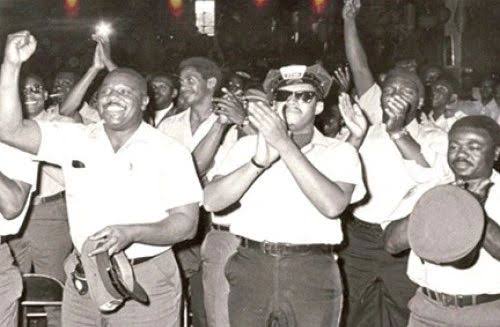
The Concerned Transit Workers (CTW) was a militant, rank-and-file organization of predominantly Black transit workers in Chicago, Illinois. The CTW formed part of the broader wave of militant Black worker organization that produced more well-known organizations such as the League of Revolutionary Black Workers. The organization repeatedly launched bold, combative wildcat strikes against both the racist union leadership of Amalgamated Transit Union (ATU) Local 241, and the Chicago Transit Authority and city government. The most significant of these actions began on August 25, 1968, in the midst of Chicago’s hosting of the Democratic National Convention. The strike shut down nearly half of the city’s bus routes and lasted for almost two weeks, demonstrating the enormous power of Black transit workers when they acted collectively and independently of the official union leadership. The strike also drew support from the Black Panther Party, whose chairman Bobby Seale organized solidarity actions in support of the striking workers.
The 1960s and 1970s saw a great upsurge in the Black liberation struggle, reaching the highest peak it had reached up to that point. The Civil Rights Movement had won important victories against the legal system of Jim Crow, but these victories did not eliminate the underlying economic and social conditions facing Black people. The Great Migration had transformed millions of Black people from a predominantly Southern and agricultural population into an increasingly urban and industrial working class. As Black workers became concentrated in factories, transportation systems, and other major industries, the struggle against national oppression increasingly entered the workplace. As Black workers and community members began to challenge not only segregation and discrimination, but also the economic and political institutions that maintained their oppression. This produced a new wave of militant Black worker organization, as workers formed independent organizations to challenge racist employers and union bureaucracies alike. In addition to struggling with economic issues such as speedups, discriminatory hiring practices, harassment of Black workers by racist foremen, and low wages, these organizations also raised anti-imperialist demands, fervently supporting the anti-colonial struggles taking place across Africa, as well as the struggles of the Vietnamese and Palestinian peoples. The CTW emerged within this broader period of struggle, bringing the fight for Black liberation and opposition to imperialism directly into the workplace.
Chicago became one of the major centers of this new period of Black working-class struggle. The Great Migration had transformed the city into a major center of Black industrial labor with the cities Black population increasing by over 700,000 between 1910 and 1960. Despite this discriminatory housing, employment, and political practices concentrated Black workers in segregated neighborhoods and some of the city’s most difficult and dangerous jobs. These contradictions were particularly sharp within Chicago’s transit system. By 1968, Black workers made up roughly 72 percent of the city’s 6,200 bus drivers, making them the overwhelming majority of the workforce. Yet this growing Black workforce remained politically marginalized within Amalgamated Transit Union Local 241, whose leadership was entirely white. The union’s structure further limited the political power of its Black membership by allowing retired members, who were disproportionately white, to retain voting rights. As Black workers became increasingly militant in the broader struggle for liberation, their demands for greater control over their workplace and union increasingly came into conflict with the conservative racist union bureaucracy.
In 1967, two Black bus drivers were fired following an argument with two white Chicago Transit Authority police officers, while the officers involved faced no consequences. The firings intensified the existing frustrations of Black transit workers, who faced blatant racism and unequal treatment on a daily basis. In response, Black transit workers spontaneously came together to devise a plan for a one-day sickout at the Kedzie-Van Buren station. The action successfully won the reinstatement of the fired workers, but, importantly, it also demonstrated the power of rank-and-file workers to organize and take collective action independently, without the backing or approval of the local state union leadership. Raising not only the class consciousness of the workers at the Kedzie-Van Buren station but inspiring workers at other stations across the city.
Seizing on this growing militancy, Standish Willis and several coworkers began organizing meetings to discuss the problems facing Black transit workers and how they could collectively fight them. What began humbly, with a handful of bus drivers gathered around the kitchen table in Willis’s West Side apartment, quickly grew as word of the sickout and the organizing meetings spread. Workers from other stations began attending, bringing with them their own experiences of racism, harassment, and exploitation on the job. As participation grew, the meetings were eventually moved to churches and schools to accommodate the expanding number of workers. What began as a spontaneous act of rank-and-file resistance was developing into a broader organization through which Black transit workers could consciously organize themselves, develop their own demands, and challenge the authority of both Chicago Transit Authority management and the existing union leadership. Soon enough, this budding organization took on a name: the Concerned Transit Workers. Representatives were elected from among the workers, and the organization began to develop a concrete program of demands to present to both the union and the Chicago Transit Authority.
In stark contrast to the ATU, which routinely silenced dissenting voices, particularly those of its Black members, the CTW emphasized rank-and-file democracy as a central principle of its organization. Decisions were made collectively at mass meetings, where all members were encouraged to raise criticisms, debate proposals, and voice their opinions. The organization’s leaders, all elected from the rank and file, were accountable to the membership and could not act without the support of the workers themselves. In this way, the CTW sought to place decision-making power directly in the hands of the rank and file, rather than concentrating authority in the hands of a few union officials.
Initially, the CTW sought to reform the ATU from within. Throughout the spring and early summer of 1968, the organization focused particularly on the issue of retiree voting. Because the CTA did not begin hiring Black workers until 1945, Local 241 of the Amalgamated Transit Union had accumulated a large pool of retired white bus drivers, even as Black workers made up the vast majority of Chicago’s active bus drivers. These retirees continued to participate in union elections and consistently voted to preserve an all-white leadership of the local. The CTW repeatedly attempted to raise the issue of retiree voting at union meetings, only to have white union members move to adjourn. The motions were immediately seconded and carried, effectively shutting down any discussion of the issue.
Fed up with these repeated attempts to silence them, the CTW decided that it would have to take matters into its own hands. On June 30, 1968, Local 241 held another union meeting, where CTW members once again raised the question of retiree voting. As expected, Local 241 President James J. Hill moved swiftly to end the meeting. Eugene Barnes, representing the CTW, demanded that Hill reopen the meeting, warning that if he refused, the organization would launch a strike. Hill ignored the demand and walked out.
The following day, thousands of Black bus drivers, joined by a small number of white allies, walked off the job under the leadership of the CTW. The strike effectively shut down nearly the entire Chicago transit system for five days, disrupting service for approximately 300,000 of the city’s 380,000 regular transit riders. The strike ended only after Chicago Mayor Richard J. Daley met with the CTW for seven hours and agreed to address the organization’s demands. The ATU leadership was outraged that the city had negotiated directly with the CTW, arguing that the mayor was legitimizing the “unlawful conduct of a reckless band of self-appointed dissidents.”
Following the strike, the CTW once again attempted to work within the ATU, entering into negotiations with Hill. After several weeks, however, the union offered its Black members only a handful of token positions, which the CTW promptly rejected as inadequate. At the same time, Mayor Daley failed to follow through on his promises to address the poor maintenance and cleanliness of the buses. Meanwhile, the all-white ATU leadership continued to shut down any discussion of retiree voting, apparently assuming that the CTW would be unable or unwilling to repeat the wildcat strike it had launched only weeks earlier. However, they were immediately proved wrong when the CTW voted to resume the strike in late August.
The timing of the strike was particularly significant, as it coincided with the opening of the 1968 Democratic National Convention in Chicago. The convention took place amid a period of intense political and social upheaval, making Chicago a focal point for struggles over the Vietnam war and racism. These thousands of protesters descended on the city to directly confront the ruling class. This created conditions for much more extensive solidarity efforts with the CTW. The CTW received widespread support from Chicago’s Black community, including civil rights organizations, revolutionary organizations, churches, and prominent Black figures such as Jesse Jackson, Bobby Seale and Muhammad Ali, spoke at CTW strike rallies. Rallies were organized to raise money to bail arrested drivers out of jail and help support their families. On weekends, drivers also spoke at churches to keep community members informed about the CTW’s activities and demands. The organization understood that the strike created significant hardships for Black Chicagoans who relied on public transportation, and therefore worked to prevent those hardships from turning into opposition to the strike. By emphasizing issues of public safety, bus maintenance, and working conditions.
The city’s police and courts responded to the strike with significant repression. Police attacked and arrested picketers and their supporters, while on August 27, a back-to-work order was issued prohibiting picketing at bus stations. Despite this repression, the strikers refused to back down. On September 8, they voted to reject the city’s final offer and demanded that the CTA recognize any labor organization representing a majority of the city’s bus drivers. The following day, police began arresting picketers en masse, further intensifying the pressure on the strikers.
The CTW soon became overwhelmed by the costs of maintaining the strike and bailing out arrested members. After three weeks, the organization called on its members to return to work, and the workers agreed. Later that fall, the ATU signed a sellout contract with the CTA that provided only minor wage increases while failing to address the central demands raised by the CTW. The CTA then passed a resolution making it a firable offense to engage in “conversation derogatory to the authority, its officials, or other employees,” as well as to “lead fellow employees into a wildcat strike, attempt to create such a strike, or participate in such a strike.” Under mounting pressure from both law enforcement and the state union leadership, the CTW eventually dissolved.
The history of the CTW demonstrates the tremendous power that exists within the rank and file when workers organize independently and collectively. The CTW emerged from the everyday experience of Black workers confronting racism, exploitation, and a union bureaucracy that refused to represent their interests. Through mass meetings, democratic organization, and militant collective action, these workers transformed their frustration into a force capable of shutting down one of the largest transit systems in the country and forcing the city government to negotiate with them directly. Although the CTW was ultimately unable to sustain its struggle in the face of state repression, financial pressure, and opposition from the union bureaucracy, its experience remains an important part of the history of Black working-class struggle.
The CTW also demonstrates that the fight against national oppression and racism cannot be separated from the struggle against class exploitation. Black workers confronted oppression not as something separate from their lives as workers, but as a fundamental part of the conditions under which they labored. Their struggle against unequal discipline, discrimination, and union exclusion became a struggle over who would have power in the workplace and in the union itself. In this sense, the CTW’s history is a reminder that revolutionary labor organizing requires more than simply fighting for better conditions
For revolutionary workers today, the history of the CTW offers both inspiration and lessons. Its greatest strength was its ability to turn spontaneous resistance into conscious organization and to connect the struggles of Black workers in the workplace with the broader struggle for Black liberation. Its defeat, meanwhile, demonstrates the immense obstacles facing workers who challenge the state union bureaucracy. Studying these struggles is therefore not simply an exercise in remembering the past. As part of our observance of Black August, it is an effort to carry forward the lessons of those who fought before us, so that today’s workers can build the organization, militancy, and political consciousness necessary to win the struggles ahead.

