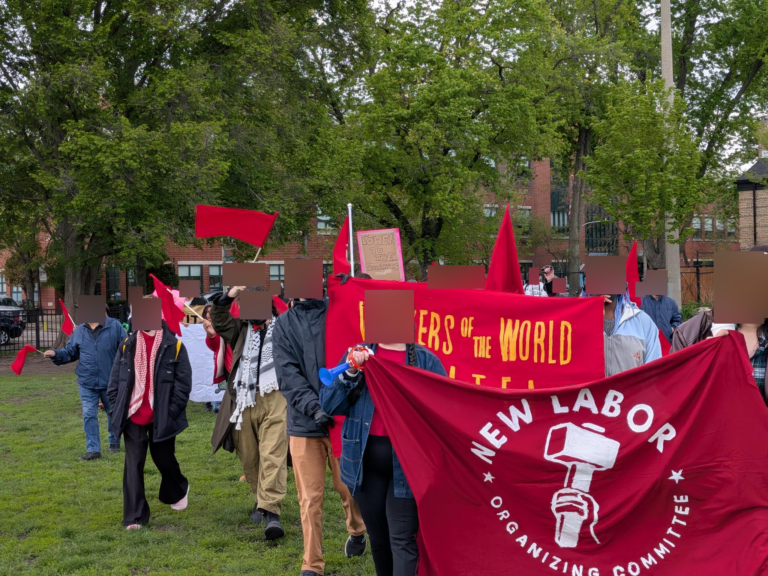
Since the founding of New Labor Press (NLP) in 2023, the political reach of New Labor has grown from a handful of workers in Massachusetts and Rhode Island to a wide network spanning coast to coast that is united by a single organization, the New Labor Organizing Committee (NLOC). As the work of NLP and NLOC has expanded, so too have we naturally encountered a wide range of responses towards our principles and line. Because the line of New Labor is made from an uncompromisingly working-class perspective, while we have received overwhelmingly positive reactions from actual workers, we have also encountered many misconceptions and straw-man arguments mainly from activists, organizers and publications who support or are only familiar with popular ideas in the establishment labor movement. In honor of International Workers’ Day, we return our focus back to some questions at the heart of the US labor movement and have written a brief education article addressing some of the common misconceptions we have encountered both in polemics against us and from new contacts and organizers on the ground.
- “New Labor is against working within the establishment unions!”
This is maybe the most frequent misconception or straw-man we encounter when dealing with contacts who disagree with or are confused by the New Labor line. It is also the most easily debunked: New Labor is not only for doing work within the establishment unions, but is actively organizing workplaces already controlled by state unions in a variety of areas and enterprises as we write this very sentence. So then where does the idea come from if it is quite literally factually incorrect?
Really, for most of the organizations that throw this out there, this claim is the admission of a guilty conscience, an admission of the opportunist understanding of what doing work within establishment unions means. The truth is that for many of these people, “working within the union” means becoming a staff organizer, tailing the union leadership, liberally avoiding open struggle with and exposure of the politics and practice of the state unions, relying on bourgeois courts and panels as the primary avenue of achieving concessions and reforms, etc. New Labor is in favor of organizing workers within the existing establishment unions, but it is not in favor of the practice and method of “red” liberalism which has become the norm on the “Left”. We believe in the slogan “class against class” and think that class-conscious workers, not capitalist experts, not middle-class staff organizers, not the labor bureaucrats, and not the imperialist government, must be the protagonists of any work that occurs within the state unions. It is only by implementing and applying the line determined by the class-conscious workers and their organizations that principled and productive work within the establishment unions can occur.
This is the essence of what we mean when we say that revolutionary workers have to start breaking with the state unions now instead of later. It means upholding the principle of the political leadership and independence of workers over bureaucrats, and upholding the line of the class-conscious workers against the lines of the reactionaries and corporatists who lord over them. It means recognizing the reality that a political-organizational split with the state union centers is an inevitability and a necessity, and we must begin mobilizing and preparing workers for such a split now rather than feeding them the delusion that revolutionaries can ever seize control of degenerate fascistic structures like the AFL-CIO.
The question of whether or not you should affiliate unionization campaigns in unorganized workplaces to establishment unions is a much more useful question in terms of demarcating the difference between the boring from within approach and the New Labor approach to independent unionism. While New Labor does work within the existing unions, we would not affiliate an unorganized workplace, or an independent union local, to the AFL-CIO or IBT, whereas such affiliation is standard practice for much of the “left-wing” activists in the labor movement. While we believe in organizing the workers wherever they are, including within the state unions, we do not believe in submitting to or ceding initiative or leadership to organizations controlled by the class enemy, especially where independent class-conscious workers have already built structures and won support through struggle. For us that is opportunism. It is betrayal. This is the true dividing line, between those who would surrender the workers to the imperialists and those who would fight till their dying breath to overthrow those imperialists and liberate our class from exploitation and oppression.
- “The New Labor line is rightist and economistic!”
This claim usually comes in three versions: 1) New Labor only believes in practice and doesn’t think theory is important, 2) New Labor is against Party-building, and 3) New Labor is for reforms and against revolution. Like with the claim that we are against working in establishment unions, all of these three are vary easily debunked by just reading what NLOC and NLP put out. Unfortunately that is a step too far for those who are desperate to attack class-conscious workers attempting to reconstitute a fighting, independent and class-conscious unionism in the United States, so instead we will explain the positions of New Labor succinctly and precisely on these points now.
The class line and political unity of New Labor is based on the theory and practice of the international revolutionary movement. This hard-won history teaches us that the working-class can only be organized to seize power and establish a new proletarian state when it is lead by its own vanguard political party, the Communist Party. Neither NLP nor NLOC are associated with or do the work of such a Party which does not yet exist in the United States. That does not mean we are against Party-building, only that we do not believe broad open organizations of masses, such as ourselves, should carry out Party-building work that is supposed to be highly selective and highly secretive.
Similarly, New Labor Press has put out a relatively large body of theoretical work on the US labor movement in three short years, and has done so using Marxism as a framework and guide. So even though the shop organizations and workers circles of NLOC do not require its worker membership to be Marxists as a criteria of entry, that is because New Labor movement is composed of revolutionary, class-conscious and progressive mass organizations of workers. It is not because New Labor only focuses on practice and doesn’t think theoretical unity and understanding is important. In our period of revolutionary work, mass organizations are relatively broad organizations belonging to the instrument of the embryonic united front. They have discipline and democratic centralism based on principles, a program, and constitutions, but are not nearly as selective as something like a Party. They are focused on mobilizing, organizing and politicizing the masses in measurable acts of class struggle against the capitalist class, with strikes, walk-outs, slow downs, etc. as well as through the struggle against opportunism within the labor movement itself.
Therefore, while NLOC is an embryonic union center, it is not and does not seek to be the embryonic center of the entire revolutionary movement. As a matter of fact, the self-appointed leaders criticizing the NLOC on this basis are themselves trying to skip over the labor movement. It is not possible to build a revolutionary workers’ party now and then figure out how the party can lead union workers later. In this way while NLOC and NLP support socialist revolution, and include support for the revolutionary process in their basis of unity, they do not pretend to be the leaders and guides of the revolutionary process in the United States. As revolutionary organizations focused on the labor movement, New Labor has a unique and special role to play, in terms of intervening in the daily struggle for demands and reforms and connecting that struggle back to the political struggle between the working-class and the capitalist class. But as labor organizations open to the masses we cannot be the overall command for the revolutionary process in the US and are not arrogant enough to pretend to be such.
New Labor views the elaboration of a complete theory for class-conscious labor as an essential task, takes the ideology of the international proletariat as a guide, and is explicit in its support for socialist revolution. It views the struggle for daily demands and reforms as site of battle where the forces of the working-class fight the forces of the capitalist class for leadership and organization of the masses, and does not view reforms as an end in and of themselves. As followers of the international revolutionary movement, we understand the need for a political Party of the proletariat and look forward to the day when that Party is reconstituted. Thus this critique is really just based on that fact that certain opportunists and confused individuals fail to understand that union organizations play a different role in the revolutionary movement than Party organizations, and as such have different principles, tasks, and activity they unite around.
- “The New Labor line is ultra-left and sectarian!”
Ironically, in addition to the claim we are rightists, at the same time we have to deal with the claim that we are ultra-leftists. This polemical attack on us is the reverse version of the second claim and, funnily enough you will sometimes find certain opportunists who have called us both. This claim usually comes from two main misconceptions: 1) New Labor is too ideological and our base of unity is too narrow/sectarian, 2) we are against unity with other “independent” labor organizations.
In regards to the first misconception, having a criteria of class and class principles cannot be mistaken for having a sectarian or narrow-minded viewpoint about unity. New Labor is unapologetically organized by and for the multinational US proletariat and its allied classes like the semi-proletariat and lower petite-bourgeosie. It is against a labor movement dominated by the ideology and politics of the imperialists and their puppets. Being against the theory and politics of the imperialists as it exists within labor movement is not being “too ideological” or having a narrow basis of unity, instead it means having principles, being for revolutionary mass work instead of counter-revolutionary mass work. Revolutionary workers must have principles, as this is a large part of what distinguishes us from the opportunists and reformists. The question is managing the contradiction between carrying out mass work based on principles, and keeping the united front as broad as possible by “uniting all those who can be united with”. This is a question New Labor investigates through social practice every day of its existence.
As for the second misconception, New Labor is for unity and actively desires unity with other independent labor organizations. The problem is that many actually-existing “independent” labor organizations are not even close to being independent or class-conscious, and instead traffic in the prestige that comes with independent unionism in order to trick workers into working under the umbrella of the state unionist trend. The biggest source of this is definitely the AFL-CIO and its constituent unions like the SEIU and UAW, who create initially independent unions or have their staff organizers take over existing independent unions in order to affiliate these unions later on to their structure. The most notable example of this is the “workers united” unions such as SBWU, however the IBT also used the same playbook with ALU. Even supposedly “independent” unions such as the IWW and the UE are really best described as “semi-independent” at best, with some locals functioning in a more genuinely independent and class-conscious way, and many other locals and the broader national leadership of those organizations theoretically and practically tailing the state unionist trend, acting as a kind of “token” or “loyal” false “opposition” within that camp.
This is often why workers become dissatisfied and disillusioned with union organizing: they desire genuine unions, but are confronted with a swamp of corrupt useless state unions, and loyal oppositions which tail them. New Labor seeks to provide the workers with leadership they spontaneously desire, and consciously guide that spontaneity into greater and greater mobilization, politicization and organization.
- State unionism is metaphysics: the establishment unions aren’t literally a part of the imperialist state!
This claim, despite the fact it is typically levied by self-proclaimed “Marxists” and “communists”, misunderstands that the ideology of the international working-class teaches us that political line is decisive in determining the class character and class stand of an organization. In this way, the state unionist thesis is primarily about the ideological-political line of the establishment unions, and secondarily about the very real ways the establishment unions are organizationally incorporated in the US imperialist dictatorship. Even setting aside this point, however, the New Labor Press has indeed documented very close collaboration between the unions and the state, through union officials attending Democratic and Republican Party conventions, testifying to Congress and taking up roles in executive branch agencies, etc. This is akin to arguing DSA isn’t part of the Democratic Party even though all their electeds caucus with Democrats, they fundraise and canvas for Democrats, and so on—it’s just dishonest.
The establishment unions, by which we mean union centers like the IBT, AFL-CIO, or Unite Here!, have political lines that are corporatist. That means they have political lines that uphold class collaboration with the capitalists so that segments of the working-class can be incorporated and integrated into the expansive system of patronage, welfare, and bribery created by US imperialism to control the exploited and oppressed masses. This typically is expressed rhetorically with language about unions “making capitalism work for everyone” or making imperialism “more fair”, and things like unions being “a part of the American system” or “American Dream”. To the state unionist trend, labor exists not as instrument of class struggle for the workers, but as a kind of legalistic balancing act necessary for modern imperialism to function, with state unionism “providing” the working class “a voice” in the capitalist system through the mediation of the state’s legal system.
This is the primary way the establishment unions are state unionist: they actively push the working-class towards integration with the state and US imperialism, and are part of the tendency towards the general corporatization of the our society and rising fascism. They have a state unionist ideological-political line in command, one which is distinct from the traditional craft unionist and business unionist lines which were dominant before the rise of the National Labor Relations Act and the New Deal welfare system. They prepare the working masses ideologically and politically for the fascist system the reactionary US capitalist class increasingly seeks to impose amid the growing generalized crisis of international imperialism, and US imperialism in particular.
In addition to the question of line, it is also undeniable that through systems established by laws such as the National Labor Relations Act, the Taft-Hartley Act, and the RICO act, the establishment unions have been significantly organizationally brought to heel and brought under the control of the literal mechanisms of the imperialist state. Furthermore, beyond the significant legal control that has been established by the state over these supposedly “private institutions”, there is intense and major financial, economic and political integration into the literal bodies and mechanisms of the state at a structural level among the major establishment unions. Lobbyists, a professionalized organizing staff oriented towards electoralism, trade union banking, the alliance between modern unionism and the upper echelons of the Democratic Party and (increasingly!) factions of the Republican Party, etc.
Saying unions like the AFL-CIO and IBT are not a part of the modern US imperialist system is like saying Planned Parenthood is not a part of the bourgeois state because on a narrow jurisdictional level it is classified as a non-profit. It is an argument that can be using only the logic of formalism, of being ignorant to the reality that exists before our very eyes.
- New Labor is pro-labor aristocracy!
Finally, it is worth briefly addressing the claim, usually made in some third-worldist and Sakaist circles, that New Labor is somehow “pro-labor aristocracy” or, in their language, conciliatory towards “settler-colonialism” in the United States.
New Labor is the only organized segment of the labor movement which upholds a correct position on the National Question in the United States, views the US as a prison-house of nations, and supports the right of self-determination for all oppressed nations within the US. Beyond that, New Labor seeks to specifically organize the nationally oppressed masses as part of its orientation towards the lowest and deepest workers, and takes as one of its primary targets the labor aristocracy and labor bureaucracy. These are points we have emphasized again and again. If these people would take a few minutes to actually look at the criticisms levied at the state unions in NLOC shop papers, they would see the state unions are routinely criticized for splitting the workers by enforcing tiered wage systems that keep immigrants and workers from the oppressed nations poor while rallying the top-tier (mostly white male native-born American) workers around the imperialist political parties. It was frankly stated in the NLP’s “The Proletariat and Class Forces in the US”, “New Labor aims to organize chiefly the proletarians, lower semi-proletarians, and workers of the oppressed nations in the US.” The introduction to the very first edition of Labor Storm said, “This publication should serve as a concrete expression of the trade-union consciousness of the New Labor Organizing Committee, provide direction for labor activists in affiliated labor organizations, and hopefully will strengthen the solidarity of workers across firms, industries, and nations.” These critics cannot provide a single example of the NLP or NLOC whitewashing American imperialism or promoting the upper stratum of workers at the expense of the lower strata because it does not exist.
We are materialists, and do not use the language of Sakaism and third-worldist “Marxism” because we view it as unscientific and incorrect. However, the reality is that to the most diehard Sakaists, any type of labor organizing is considered “pro-labor aristocracy” and economist, despite the fact that most of their idealized nationally oppressed “lumpen” revolutionary subjects are in fact semi-proletarians and proletarians who New Labor actively seeks to organize under revolutionary proletarian leadership. In this sense this accusation is simply a reflection of the theoretically eclectic and confused nature of Sakaism and third-worldism as a whole, which sometimes attacks movements like New Labor which are ironically doing the very things they claim to uphold and support.
To sum up, the path forward for the workers’ movement New Labor proposes is simple. But it is only simple when taken from the perspective of the workers, from the perspective of our class, which is why it gains traction so easily among actual proletarians and poor wage workers. When taken from the perspective of the American “middle classes”, from the perspective of a staff organizer, white-collar professional, or someone without experience dealing with actual unions as they actually exist as a worker, the line of New Labor must seem completely ridiculous. As NLOC states in their May Day statement: “The state unions sacrifice both the short and long-term interests of the workers on the altar of labor peace”. In this way, at its essence, the real dividing line is between those who are for genuine authentic labor unions, and those who are for placing the workers under the political leadership of the class enemy, under the leadership of US imperialism.
 New Labor Press