In The Eighteenth Brumaire of Louis Bonaparte, Marx said, “All great world-historic facts and personages appear, so to speak, twice… The first time as tragedy, the second time as farce.”
The Minneapolis-Saint-Paul metropolitan area, as a hub of industrial and logistical work, has been an important site of struggle for the labor movement in the US. The area is perhaps best known for the 1934 general strike, which was kicked off by drivers affiliated to the Teamsters local, and ended by the union leaders’ settlement after fighting had broken out between the armed forces and the strikers and their supporters. In January 2026, a number of labor journalists and union officials began claiming another general strike was taking place in Minneapolis-Saint-Paul. However, even a cursory examination of the facts reveals that not only did no general strike take place in the Minneapolis-Saint-Paul area in January 2026, but in fact this was a ploy aimed at disrupting the mass movement which was indeed developing at that time via misinformation.
What is a general strike and how do general strikes develop? A general strike is a strike which is not limited to one or a few enterprises, but instead is broadened to include a substantial portion of the workers in a given geographic area, generally for a prolonged period. General strikes generally develop out of smaller strikes. For instance, the 1934 Minneapolis general strike began with only truck drivers striking. The strike was able to expand because of the high level of trade union consciousness among Minneapolis workers and the unwillingness of the bourgeoisie to make concessions at that time. This led to escalation on both sides until the workers reached their subjective limit, represented in their inability to overcome the reprehensible deal the drivers’ union officials made with the bourgeoisie. The San Francisco 1934 general strike developed similarly, beginning with the dock workers and spreading to other unions as the situation escalated. The Seattle 1919 general strike also begin with dockworkers and only became “general” when other workers walked out in support of the dockworkers demands.
In none of these cases did the general strike begin with a union passing a resolution to lead a general strike. On the contrary, in San Francisco such a resolution was used by the Central Labor Council to attempt to commandeer the movement–Communist Party activist Sam Darcy described it as an attempt “to kill the strike, not to organize iti.” Campaigns for general strikes lead by revolutionary organizations have occurred historically, and have only been successful as a result of significant prior class struggle lead by revolutionaries and an elevated level of class consciousness among the laboring masses. In short, general strikes (like any other strike) have their material basis in the class struggle, not in the resolutions of the “official” trade union leadership; they typically begin with a limited confrontation between organized workers and specific bourgeois and develop according to the level of class consciousness of the masses.
The 1934 Minneapolis General Strike
First of all, there are certain facts of the 1934 Minneapolis general strike that are generally disregarded in contemporary analysis of the movement. The broad popularity of the strike wave among the Minnesota working class, and the fact that a number of unions passed resolutions endorsing a general strike, are overemphasized at the expense of the actual consequences of the general strike. The fact is that it ended not only in the defeat of the workers’ demands, but also in the subsequent liquidation of the Teamsters local that had started it. Here is how William Dunne characterized it at the time:
The drivers carried on a heroic struggle, lasting five weeks; but in the end were compelled to go back to work with no increase in wages and without union recognition. The most vital problems were once again left to arbitration and the Labor Board. Even the union is not secure because one clause in the settlement provides that a vote shall be taken among the drivers of 166 of the largest firms in Minneapolis to decide whether they want to be represented by Local 574 or by other representatives, which means the company union. The right of the workers to determine their own organization is surrendered in section 7 of the agreement which turns over the conduct of the election to the employers and the regional labor board. … Section 5 of the settlement specifically states that the inside workers shall return to work “but they shall not be eligible to vote in the election as called for in paragraph 7 hereof”. This is a desertion of the inside workers. Recognition is allowed to them in only 22 firms. The young workers and temporary workers were also deserted by the statement in paragraph 8: “It is understood that the minimum wages herein specified do not apply to boys temporarily employed on small package delivery trucks, and they shall not be submitted to arbitration.” This hits the young workers employed by the biggest department stores. The question of rehiring is subject to a preferential list. This list is to be compiled by the employers. Already discrimination is taking place through the claim of the bosses that there is “no employment for all,” at the present time. [Permanent Counter-Revolution: The Role of the Trotzkyites in the Minneapolis Strikes, emphasis added]
In short, the strike wave under the leadership of the AFL officials betrayed the demands of the young workers, inside workers, and temporary workers in exchange for a partial recognition election overseen by the government. Virtually everything was sacrificed to the arbitration board on behalf of the petty-bourgeois illusions of the strike leaders. But how this was justified at the time bears additional scrutiny because virtually the exact same excuses have been trotted out 90 years later.
For instance, Dunne criticized the general strike propaganda for being limited to union workers without contracts, essentially putting the burden for the success of the movement on the most precarious workers: “‘We call on every employed worker in Minneapolis not under contract to lay down his tools. To declare a holiday.’ For sheer anti-working class originality in devising ways and means of forming a united front with the treacherous bureaucrats of the labor movement this slogan is in a class by itself.” [ibid.] This is exactly how the AFL-CIO pitched the 2026 “general strike”-as an economic holiday for everyone… except the organized workers, because they can’t break collective bargaining agreements! This is how lazy union officials try to “square the circle” of striking without breaking no-strike clauses. They simply tell everyone else to strike for them.
Another example: “The phrase ‘an important first step’ is part of the counterfeit coin with which the leaders short-changed the strikers.” [ibid.] Today, the revisionist groups try to paint the fake general strike as a step towards an actual general strike, as will be shown later. Isn’t that a strange way of thinking—failing to organize a general strike somehow prepares the workers for a general strike? This is how union officials try to leverage the ignorance of the rank and file to trick them into abandoning their own movement. Everyone knows going back to work is “an important first step” in ending a strike. But the union officials are constantly trying to pass off their unnecessary and uncalled-for retreats as a temporary necessity to prepare the workers for another advance—which simply never happens.
What Happened in January 2026 and Labor Reporting
First of all, anyone at all familiar with the American labor movement knows the vast majority of state unions do not strike even under extreme conditions such as the COVID emergency, pay cuts, and layoffs. The New Labor Press has frequently reported on the fact that these organizations maintain close contact with the Trump administration, and the Biden administration before that. The state unions are determined to maintain their collective bargaining agreements with the bourgeoisie at all costs to ensure revenue from dues, which means honoring the no-strike clause which all these contracts contain. So any claim of a strike, an actual on-the-ground economic action, by these unions needs to have actual evidence backing it up, not just cite social media posts and union official quotes.
This leads to the second point. This supposed “general strike”, if it really occurred, would have left some evidence of preparatory work. Mainly, these unions would have at the very least held a strike authorization vote to ensure there was actual support among the membership. But in fact no such thing happened. On the contrary, the unions told their members they were expected to show up to work on the day of the protests. The unions that supposedly participated in this general strike themselves do not claim to have been a part of such an effort. For example, the Minneapolis Regional Labor Federation and the Minnesota AFL-CIO sites make no mention of a general strike and the AFL-CIO’s own strike tracker shows the only strike action in the state was the Starbucks strike initiated well in advance. The Minneapolis Teamsters released a statement saying, “As a patriotic organization, we will always support the United States Constitution and the rule of lawii.” So there is a curious dearth of corroborating evidence that dates from before the alleged initiation of the strike.
Thirdly, there would have been a reaction from the bourgeoisie, which in fact voluntarily closed many businesses on that day knowing it would be chaos. There would have been unfair labor practice charges, mass discipline, etc. The Department of Labor would show strikes initiated on that day and a huge number of lost work days. Really, the entire labor movement would have been affected, because this general strike would have overturned 90 years of legal precedent in one stroke. It has been well-established by now that the American state unions, as agents authorized by the National Labor Relations Act to represent the workers, are liable for losses incurred during work stoppages. (See the Cemex case.) For this reason, they are expected to—and do—function as opponents of work stoppages under all conditions save for the extremely specific case of an unfair labor practice strike with advanced warning to the state. Have there been any secondary ripples in the state or throughout the labor movement following a collapse in this representative system under the weight of a general strike in Minneapolis? Obviously not.
So what actually happened? What actually happened was a huge protest occurred, during which many businesses closed and an unknown number of wage laborers called out sick to protest. But that is not the same thing as a general strike. It is being deliberately misconstrued as a general strike by the same people who were falsely claiming 2023 was a historic year for the labor movement. Essentially, the liberal bourgeoisie (which these unions follow) is trying to create the appearance of resistance to Trump to dupe the workers into complacency. It is typical of capitalist media to whip up hysteria around protests, portraying them as much more organized and militant than they actually are. What is new is that these false accounts are being exploited by the state unions to cover up their own role in the Trump administration, which goes back to Trump’s Great American Economic Revival Industry Groups.
These lies are legitimately despicable because the unions which supposedly participated in this general strike in actual fact participated in putting down the protests. Teamsters local 120 represents law enforcementiii. The AFGE, an AFL-CIO affiliate, represents border patrol officers and admitted the officer who murdered Alex Pretti may have been a member of their unioniv. Isn’t it strange how easily these facts are swept under the rug?
Unfortunately, it is not strange at all. The same thing happened in 1934, when Minneapolis did see a strike of drivers which paralyzed the local economy and led to the bourgeoisie imposing martial law. As a matter of fact, that general strike was also defeated “from within”, by the AFL and by the Trotskyite leaders. In both cases, the masses were confronted with a major contradiction between the popular sentiment in favor of a general strike and the actual level of organization of the masses, who were largely dependent on reactionary leadership working in alliance with the liberal bourgeoisie. In short, during a period of upheaval, the subjective situation of the masses violently shifted far ahead of what objectively they could accomplish. This is why the NLP has always been in favor of independent labor organizing. Instead of relying on the decisions of state union executives—which, even if they do favor a general strike, they can’t actually organize it—the masses need to rely on their own initiative.
Of course, the vast majority of labor reporters do not uphold the New Labor line. For these people, it makes total sense to take the statements of union officials at face value. Here are some examples of how the January 2026 events in Minneapolis were covered in the labor-liberal and revisionist press:
Jacobin published an article that approvingly quotes the very state union officials that failed to organize a general strike while cynically exploiting the false advertising on social media. They falsely describe the January 23 protest as “an ambitious mass strikev.” They go on to claim, “In fairness, the community organizations that initiated January 23 and the student groups that initiated January 30 did not project these as ‘general strikes.’ That framing was subsequently pushed by influencers, celebrities, and left activists online.” This is an outright lie. Labor Notes published an article by the City University of New York Labor Studies’ professor Stephanie Luce titled “How to Spread the General Strike Beyond the Twin Citiesvi”. The official United Electricians X account referred to it as a strikevii. The UAW (which is an AFL-CIO affiliate) released a statement which said, “Unions in Minnesota took action last Friday, January 23, by participating in a general strike and protested across the stateviii.” Unless Jacobin is prepared to describe the UAW and Shawn Fain as just an “influencer”, they need to retract this. (Not to mention the fact that the article itself refers to the January 23 protest as a strike.) They won’t, because the purpose of this lie is to make it seem like the union officials weren’t being dishonest, but merely misunderstood by overly enthusiastic “left activists online”.
The revisionist statements are actually much worse though. It is clear from how these are written that the authors were well aware of the fraud and just did not care. For instance, The Worker reported: “Workers and activists across the country joined protests on Friday, January 30, in what has been described as a ‘general strike’ mainly against Immigration and Customs Enforcement (ICE) terrorix.” Why put general strike in mock quotes? Because as the article admits, “Protesters answered the call to action in many cities, though they more often [!] took the form of peaceful parades corralled by Democrat-aligned groups rather than workers’ strikes.” This is like if Trump himself was a labor journalist—“I’m not saying this, many people are saying this!” The Trotskyist Independent Socialist Group was even more transparent. In an article titled “The Independent Socialist Group Stands With the Call for a General Strike and Day of Action in Minneapolis”, the ISG demands, “Minneapolis labor unions to make the day of action a real strikex!” So even though they admit it was a fake strike, they nonetheless “stand with” the fraudulent general strike call in Minneapolis. This is an echo of what Dunne pointed out above about the “counterfeit coin”. The Workers’ Liberty organization went so far as to publish an article titled, “One-day general strike in Minnesota” which has as its source an AFL-CIO statement that never even uses the word strikexi.
Wikipedia, as an aggregator of bourgeois sources, listed basically all of the major unions as participating in the general strike and their sole source was a UE statement which, again, does not use the term “general strike” oncexii.
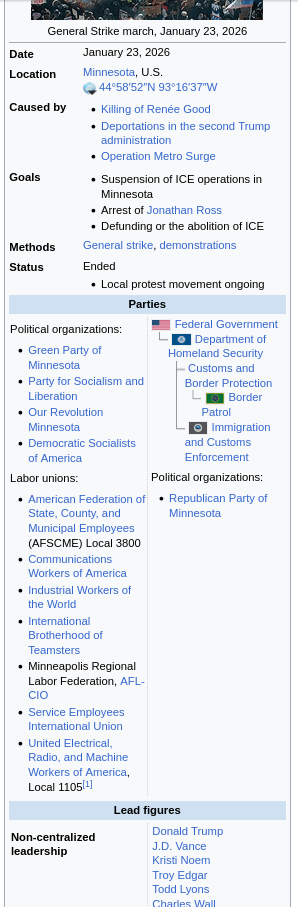
Retrieved from https://web.archive.org/web/20260203084418/https://en.wikipedia.org/w/index.php?title=2026_Minnesota_general_strike
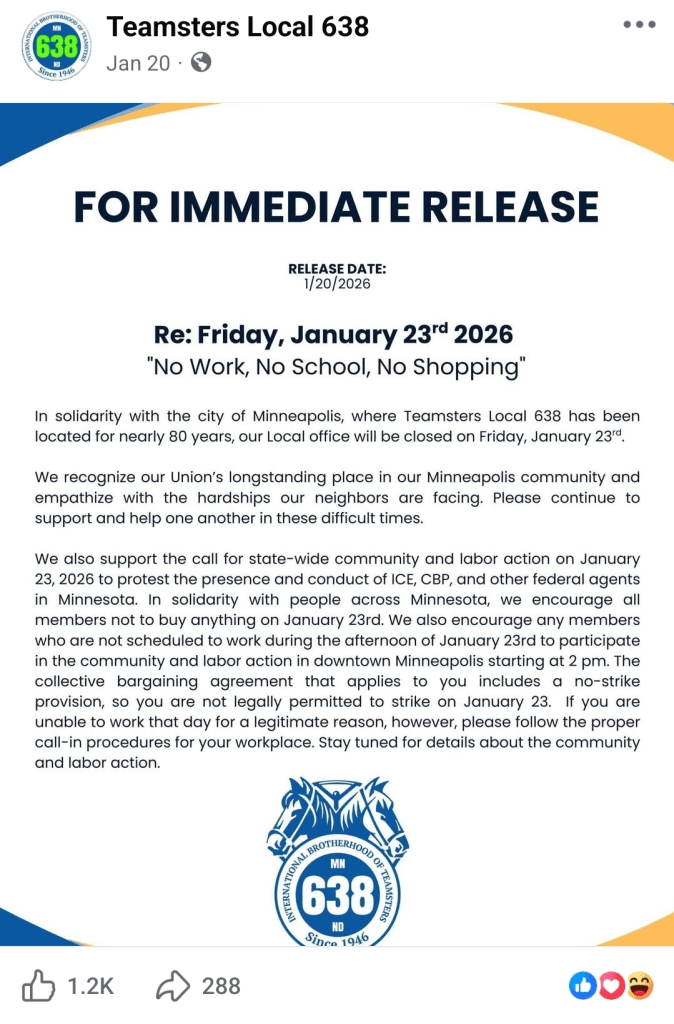
Is any of this an accident or the result of some kind of linguistic mishap?
Of course not. This type of circular, inaccurate, non-commital reporting follows its own logic—the logic of profit. Actually investigating things costs money and time which cuts into margins. For people blinded by bourgeois ideology, the statements of the “official” labor representatives on Twitter and elsewhere are just as good, if not better than, the statements of the actual workers familiar with the facts on the ground. Lucky for New Labor Press, there is a foolproof method to cut through the mass of misinformation. It’s called actually talking to workers. The second this is done, the whole thing is exposed as a mutually reinforcing network of lies. For instance, the Cornell Labor Tracker listed the Fairview Ave Starbucks in Minneapolis as being on strike, and the broader SEIU as having participated in this general strike. But all NLP had to do was send someone to that store to find out in fact they were not on strike. A conversation with a pro-union barista revealed the following about SEIU’s “organizing” in the area: “I never know what’s going on with the union… [a nearby Starbucks] strikes and the way we find out about it is all the customers come here.” Another barista claimed, “The consensus is we can’t afford to strike even with the strike fund. Frankly, we don’t even want to be here normally.” Isn’t this curious? SEIU is essentially setting up its own workers to scab on their strike while misreporting the actual scope of the strike. The SEIU is then uncritically repeated by Cornell’s “labor studies” program—which is really just an aggregator of state union statements and labor liberal articles shared on Twitter—and the actual workers who are being “organized” have no clue any of this is going on!
Consider Cornell’s sources for the Minneapolis general strike listed in their labor tracker. (Keep in mind, this is an Ivy League school.) Their “sources” are: Labor Notes, Bring Me the News, American Prospect, and In These Times.
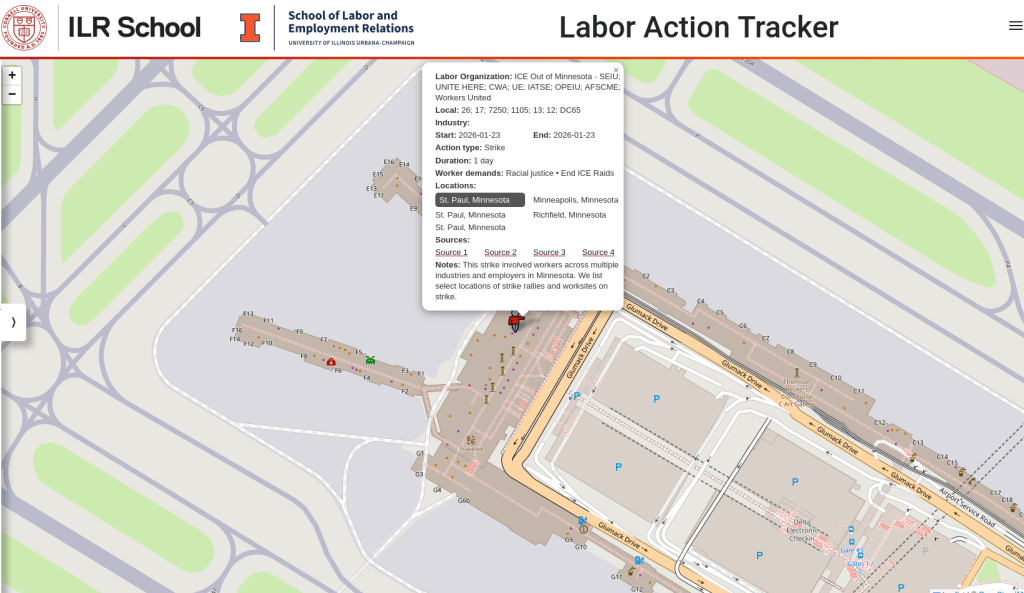
Even though these sources are supposed to back up the existence of a general strike, they are actually unanimous in their explanation that what actually occurred was a sick-out. For instance, the Labor Notes article says, “Multiple union sources confirmed that they were giving members a nod-and-wink to skip work by raising safety concerns, using sick days or personal days to work around no-strike clausesxiii.” This directly contradicts the idea that these unions were organizing a general strike. The Bring Me the News article is about a ULP strike which happened to take place at the same time as the protestsxiv. The American Prospect article is also about a sickout—“about 50 workers at his store… called in sick to participate in the statewide day of action”—at an unorganized Target storexv. And the ITT article quotes a UNITE HERE steward who also claimed many coworkers called out sickxvi. Is it conceivable that these Ivy Leaguers do not understand the difference between a sick-out, a ULP strike, and a general strike? Or, more likely, that they just didn’t care to report the facts?
The New Strike Strategy: Just Lie
It must be noted that this phony general strike did not just spring up from the imagination of union officials in Minnesota. The new trend in the state unions, going back at least to the 2023 “stand-up strike” by the UAW and the “credible strike threat” by the IBT, is to just lie about striking. This way, they can reap all the press about striking without actually having to spend money or time organizing and executing a strike or deal with any of the legal blowback.
In 2023, the Teamsters said, “General President Sean M. O’Brien took UPS to task, harshly reiterating that the Teamsters will not work beyond July 31 without a new contractxvii.” Yet this is exactly what they did, keeping workers on the job past July 31 after spending the entire summer blustering about a “credible strike threat”. Then that winter, without any strike authorization vote or organizing, they again claimed, “Teamsters in Louisville May Strike Over Unfair Labor Practicesxviii.” Then again, in August of 2025, they said, “United Parcel Service (UPS) bowed to a credible, coordinated strike threat authorized by the International Brotherhood of Teamsters around midnight after the union demanded the multibillion-dollar corporation cease multiple attacks on workers’ rights. With picket lines ready to assemble in the early morning hours Tuesday across seven states, the Teamsters secured a handful of settlements from UPS on outstanding grievances as well as a first contract for newly organized workers. At the direction of General President Sean M. O’Brien, Teamsters were prepared to strike UPS at its largest air hub, Worldport, in Louisville, Ky., and across the Chicago area, and to extend picket lines to California, Massachusetts, Pennsylvania, Georgia, and Ohio if UPS did not retreatxix.” This was never voted on by the members, nor was there any organizing done in those states. NLP knows for a fact that the UPSers in Massachusetts and elsewhere were never even told of their supposedly imminent strike.
In bourgeois legal terms, what we are looking at is fraud and deceptive business practices with different revisionist and liberal organizations acting as accessories after the fact. These unions are advertising a service (a general strike or just a regular strike in the Teamsters’ case) that they do not provide in reality, in order to shake down people for dues money and maintain their control over the labor movement. The problem is, a phony struggle can only result in a phony victory. The non-existent general strike in Minneapolis resulted in the non-existent liquidation of ICE’s presence in Minnesota—thousands of agents remain and the concentration camps are only expandingxx.
If it was true that the AFL-CIO and IBT broke their collective bargaining agreements to wage a general strike against the DHS, that would totally obliterate the line of New Labor. On the other hand, if it were true that there was no general strike and the unions were deliberately lying to cover up their own role in “organizing” police and border patrol agents, this would vindicate the New Labor line. And in fact this is what happened. The Minneapolis protests in January, at one stroke, completely exposed the “militant” pretenses of the official labor movement. The “labor experts” in academia showed themselves to be nothing but aggregators of junk data from Twitter and the revisionist publications. The revisionists are nothing but accessories to the state union fraudsters. The state union fraudsters have no ability to wage a militant struggle against fascism and can do nothing but call out sick from work and pass worthless resolutions while collecting dues from law enforcement. In order for any mass movement to achieve victory on any scale in the US, these exact elements must be thrown out of it.
Conclusion
Like in 1934, in Minneapolis-Saint-Paul, support for a general strike was developing among the masses. There was huge support among the workers for a work stoppage. People took to the streets well in advance of any sort of proclamation by the reactionary union leaders, and were promptly met with violent repression by the government. But the real wrecking activities were not done by the ICE thugs or the local police. The real wrecking was done by the labor and community organizations, working hand-in-glove with the capitalist press, and supported by the revisionists, to mislead the masses.
For the bourgeoisie and the state union officials, the massive amount of misinformation about the labor movement isn’t a bug. It’s a feature of the movement that they have deliberately fostered. In fact, this is only getting worse. The media is already making noise about a so-called “2028 general strike”. This is a massive fraud being used to trick workers into not striking now—while workers are upset with Trump and the economy and are already taking to the streets in record numbers—and instead wait until 2028 after Trump has already done everything he wants to do. (It is also worth noting this “general strike” was proposed by the UAWxxi, who no doubt want to cover up the consequences of their laughable “stand-up strike” which kept the majority of workers on the job and was followed by a huge amount of layoffs similar to the Teamsters’ “credible strike threat” at UPS.) At which point the unions will then not have a general strike because in fact all that is being proposed is aligning contract campaigns for 2028—no preparatory work like strike votes among the members, organizing strike committees in the shops, recruiting strike captains in unorganized shops, or propaganda work among union members who don’t support a general strike is actually being done. This is purely a diversionary tactic—just like in Minnesota—now aimed at creating the illusion that the state unions (and by association the Democrats) are resisting Trump’s fascistization.
There are two important lessons to be drawn from the events of January 2026.
The first lesson is that large sections of the masses—meaning not just the proletarians, and not just the working class, but even chunks of the petty bourgeoisie—have been drawn into the conflict with the fascist thugs employed by American imperialism. Hundreds of thousands of people across major metropolitan areas have demonstrated against ICE, thousands of small business owners closed their shops in support of these demonstrations, and an unknown number of students walked out and workers sicked-out in support as well. Therefore, the issue is not a lack of support among the masses, but a lack of organization among the majority, and for the organized minority, a weak political line.
Thus the second lesson. The second lesson is that the state union leaders and reformist organizations are willing to work jointly with the state, the corporations they hold CBAs with, and the press to maintain their position at the head of this movement in spite of their opposition to its aims. The bourgeois press lies on behalf of the state unions, because if people think these unions will organize a general strike and lead the people into a militant uprising against ICE, they won’t feel a need to do it themselves. But the reality is the opposite happened. The people spontaneously rose up against ICE, and the union leaders falsely promoted themselves as leaders of the movement, and in turn, the revisionists falsely promoted themselves as supporters of both the actual uprisings and the lying state union leaders that they tail.
Ultimately, what happened was a repeat of the events of 1934 but under new conditions. Formerly, it was possible to mobilize—albeit to a limited extent—the masses inside the framework of the established unions. Once this limit was reached, however, a sellout became imminent, which indeed did happen 1934. Now, there is no such possibility. So to even speak of a sellout in January 2026 would be wrong—there was no struggle by those unions to sell out. The only thing that remains is a series of hypocritical resolutions and hack journalism.
i https://www.foundsf.org/The_General_Strike_of_1934
ii https://www.teamsterslocal320.org/news-details/news/news/9834/97473
iii https://www.teamsterslocal120.org/about-us/our-local/
iv https://jewishcurrents.org/alex-prettis-killer-may-be-part-of-his-union
v https://jacobin.com/2026/02/ice-minneapolis-general-strikes-trump
vi https://www.labornotes.org/2026/01/how-spread-general-strike-beyond-twin-cities
vii https://x.com/ueunion/status/2019157699469144551
viii https://uaw.org/statement-from-uaw-president-shawn-fain-on-the-killing-of-alex-pretti/
ix https://theworker.news/2026/02/02/hundreds-of-thousands-join-countrywide-january-30-general-strike/
x https://independentsocialistgroup.org/2026/01/20/the-independent-socialist-group-stands-with-the-call-for-a-general-strike-and-day-of-action-in-minneapolis/
xi https://www.workersliberty.org/story/2026-01-26/one-day-general-strike-minnesota?language_content_entity=en
xii https://www.ueunion.org/ue-news/2026/local-1105-shuts-down-the-umn-for-the-january-23rd-day-of-truth-and-freedom
xvii https://teamster.org/2023/06/teamsters-to-ups-youve-got-one-week/
xviii https://teamster.org/2023/12/obrien-to-ups-teamsters-in-louisville-may-strike-over-unfair-labor-practices/
xix https://teamster.org/2025/08/at-11th-hour-ups-bows-to-teamsters-strike-threat-in-7-states/
xx https://www.pbs.org/newshour/politics/trumps-border-czar-says-drawdown-of-ice-agents-in-minnesota-continues-but-smaller-force-will-remain
xxi https://www.thenation.com/article/activism/general-strike-2028-unions-labor-movement/
 newlaborpress.org