
“During the course of almost forty years we have stressed the class struggle as the immediate driving force in history, especially the class struggle between the bourgeoisie and the proletariat, as the powerful lever of the modern social transformation: therefore we cannot go hand in hand with people who want to delete this class struggle from the movement. On forming the International, we expressly formulated the battle cry: the liberation of the working class must be the work of the working class itself. We consequently cannot go hand in hand with people who openly declare that the workers are too uneducated to liberate themselves, and must be liberated from above at the hands of philanthropic big and petty bourgeois.”
– Marx and Engels, Selected Letters
Despite Marxist pretense, the reality is that the revolutionary movement in the United States is in such a backwards state that there is widespread confusion on who even is a worker, much less the interests and characteristics of the different segments of the laboring masses within the US. Therefore, with this article New Labor Press seeks to more precisely outline a few basic definitions of what being a proletarian means, and how that applies to understanding how exactly the working population within our country is divided, and what contradictions arise based on these divisions. This is particularly important in combating the state unionist trend, which arbitrarily lumps together grad students, full time lobbyists and state officials, and wage workers along corporatist lines at the expense of the actual workers’ rights and class interests.
The main mass of the working population is the proletariat, which is the only class capable of leading the revolution and abolishing class altogether. It must be noted that proletarian is not synonymous with simply being a wage worker. Marx defined the proletariat in The Communist Manifesto in this way:
“In proportion as the bourgeoisie, i.e., capital, is developed, in the same proportion is the proletariat, the modern working class, developed; a class of laborers, who live only so long as they find work, and who find work only so long as their labor increases capital. These laborers, who must sell themselves piecemeal, are a commodity, like every other article of commerce, and are consequently exposed to all the vicissitudes of competition, to all the fluctuations of the market. Owing to the extensive use of machinery and to division of labor, the work of the proletarians has lost all individual character, and, consequently, all charm for the workman. He becomes an appendage of the machine, and it is only the most simple, most monotonous, and most easily acquired knack, that is required of him. Hence, the cost of production of a workman is restricted almost entirely to the means of subsistence that he requires for his maintenance, and for the propagation of his race. But the price of a commodity, and therefore also of labor, is equal, in the long run, to its cost of production. In proportion, therefore, as the repulsiveness of the work increases, the wage decreases. Nay, more, in proportion as the use of machinery and division of labor increase, in the same proportion the burden of toil also increases, whether by prolongation of the working hours, by increase of the work exacted in a given time, or by increased speed of the machinery, etc.”
Thus there are, in fact, three criteria that must be met for a person to actually be specifically proletarian: first, they must be a wage worker, meaning they sell their labor, more precisely their labor-power; second, the actual quality of the labor must be social; third, the remuneration for this labor must be limited to what the worker needs to live, i.e. not be enough to permit them to rise to the level of petty-bourgeois. Engels succinctly summarized it as, “The class of the wholly propertyless, who are obliged to sell their labor to the bourgeoisie in order to get, in exchange, the means of subsistence for their support. This is called the class of proletarians, or the proletariat1.” In the United States, this is both the largest, and among the least organized, section of the working class.
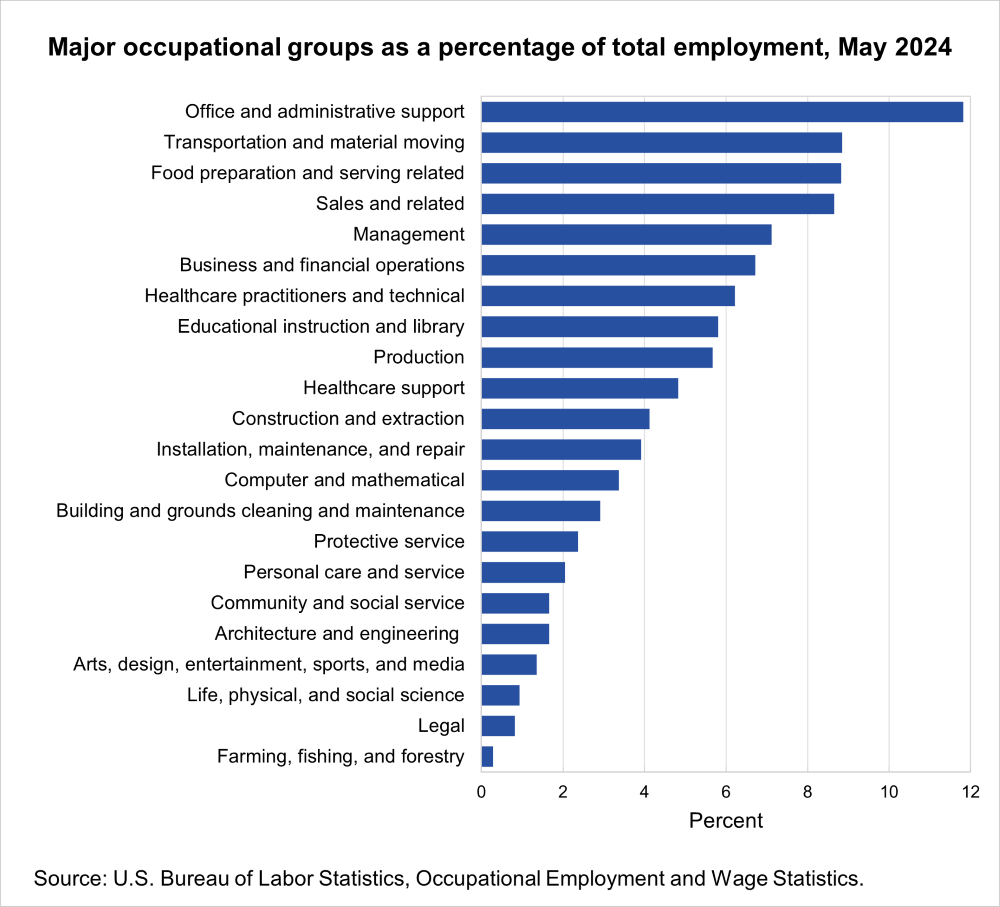
If we use Bureau of Labor Statistics (BLS) data, which are useful for estimating class forces even if they are not entirely scientifically precise from a Marxist perspective, production occupations employed 8.7m as of May 2024 (5.7% of the total workforce) with a mean wage of $50k2. Transportation and material moving (aka logistics) were more than 8% of the workforce, food preparation and service were also more than 8% of the workforce, and construction and extraction were more than 4%. In addition, which is not measured well by the BLS categories, the lower layers of the healthcare, maintenance, and cleaning sectors also constitute proletarians as they are wage workers, their labor is socialized, and they receive wages which are only enough to socially reproduce their current class status and not invest or purchase property. We roughly estimate these lower levels as constituting 10% of BLS’s total employment count, which does not even cover the sections of proletariat which work under-the-table or as undocumented laborers. In this way, these sectors constitute at a bare minimum roughly a third of the entire working population—more than 40 million people—and form the hard core of the revolutionary proletariat.
Nearest to the “hard core” proletariat is the semi-proletariat. These are the wage workers who do not meet all three criteria of the proletariat as defined by Marx. In this sense the semi-proletariat is actually divided into two distinct layers: either a wage worker is not fully proletarian because they are paid well or possess a unique skill that removes them from the socialized stages of production (the “upper” semi-proletariat), or they are not fully proletarian because their marginalized or precarious conditions of living and work similarly remove them from either socialized production, or regular employment (the “lower” semi-proletariat).
Among the lower semi-proletariat we find some of the poorest and deepest masses. These workers are often misunderstood by some on the “Left” as being part of the lumpen proletariat, when they are in fact more correctly understood as semi-proletarian members of the broader multinational working-class. They include among their ranks groups like irregularly employed day laborers, certain types of gig workers, elderly or homeless people who work semi-frequently at the margins of society. They are not fully proletarianized workers insofar as their employment is inconsistent, and their role in socialized production is similarly unstable, however they nonetheless survive through selling their labor power, and when they do work it is often in proletarian industries and fields.
The actual lumpen-proletariat was defined by Marx as, “a mass sharply differentiated from the industrial proletariat, a recruiting ground for thieves and criminals of all kinds living on the crumbs of society, people without a definite trade, vagabonds, gens sans feu et sans aveu [people without hearth or home], varying according to the degree of civilization of the nation to which they belong, but never renouncing their lazzaroni [reactionary poor people who supported monarchy] character3.” This is that section of the population which is marginalized and only occasionally contributes labor to society, not infrequently finding other parasitic or non-productive sources of income such as larceny, begging, or illicit trading and other rackets. We cannot misunderstand the poorest and most precarious sections of the working class as “lumpen”. In reality these workers are often the lower layers of the semi-proletariat, whereas the lumpen-proletariat itself are those who survive primarily through begging, theft, or criminalized capitalist endeavors such as the drug trade or prostitution. While there is certainly overlap in some cases, they are nonetheless two distinct sectors of class society.
Both the lower semi-proletariat and the lumpen proletariat are difficult to map out precisely using government data, given their marginal conditions. Nevertheless, by most anecdotal and existing quantitative metrics the lower semi-proletariat is much larger than the lumpen-proletariat, even if the lumpen has a more significant imprint on the middle-class cultural imagination of the poorest workers and neighborhoods.
Then there is the upper semi-proletariat. Whereas the lower semi-proletariat is often a product of the trend of capitalism towards creating a lower “reserve army of labor” of unemployed or semi-employed wage laborers, the upper semi-proletariat is a product of another trend of capitalism: the death of the artisan class and the narrowing of all class distinctions into that of the proletariat and bourgeoisie. Thus over time, the more numerous lower segments of the petite bourgeoisie become proletarianized while the upper sections become more bourgeoisified. One might think about the huge logistics warehouses that have several hundred unskilled package handlers who process work using the machinery, versus the handful of specialized repairmen who keep the machinery running. Another example would be those sections of the former professional or artisan classes who have been proletarianized under modern capitalism via the growth of socialized production. The line between the upper-semi proletariat and the lower petite-bourgeoisie thus becomes blurred under modern capitalism, as the middle classes are increasingly proletarianized and organized into socialized production, and the working-class turns to gig apps and online market places to create “side” income streams in order to make ends meet. In this sense there has developed a lower section of the petite bourgeoisie that is organized along proletarian lines in the modern imperialist economy, and which composes a majority of what could be referred to as the “upper” semi-proletariat.
The largest sections of the upper semi-proletariat are the salaried educators (about 6% of the working-class), healthcare specialists like nurses, the more well-paid full-time gig workers, and those wage laborers who have side businesses selling crafts or goods often on online marketplaces. Of course, many of these people are either coming out of the proletariat or being cast back down into it. Note that quantity itself develops into a quality when it comes to wage laborers and the semi-proletariat especially. For instance, there are roughly 2.5m people employed in Architecture and Engineering Occupations with an annual mean wage over $100k. This is a highly specialized field involving intellectual labor. This means that the lower stratum in this occupation would be semi-proletarian—as they are relatively less-exploited wage laborers—while the bulk would be considered petty bourgeoisie, i.e. people running their own small business or wage laborers who have saved up enough to acquire property like housing they can rent or stocks they derive interest from. There are over 2m people employed in Software and Web Developers, Programmers, and Testers, with an annual mean wage over $135k. Even Healthcare Practitioners and Technical Occupations, which includes the more than 3m registered nurses, have a six-figure annual mean wage. (RNs have a median wage of $93k4 ) This places these people well above the median annual wage of approx. $62k5.
Socialism is impossible without the support of these skilled workers, but at the same time organizing in these occupations needs to take their privileged position relative to the proletariat into account. Bringing these people into the labor movement is necessary but this means bringing their mistaken ideas and prejudices, resulting from their proximity to the stand and outlook of the petty-bourgeoisie, into the labor movement at the same time. This is why ideological education, exchange of ideas between lower and higher levels, and structured unity-struggle-unity processes—such as the NLOC seeks to do with Industrial Unity Committees—are an absolute necessity in labor organizing. Without an active and thorough-going force of revolutionary political leadership, each new organized upper semi-proletarian worker actually weakens the political line of the labor movement by diluting it with their own underdeveloped consciousness.
Additionally, the bourgeois state directly employs 20.2 million people in the US, approximately 14.5 percent of the workforce6. Many of these workers could also be considered members of the upper semi-proletariat. This is its own contradiction. On the one hand, state employees can plainly see that they are being exploited by the bourgeoisie collectively and not just by a “bad apple” company. (USPS is a textbook example of this.) On the other hand, these workers are better compensated and mainly do intellectual labor, which creates the subjective impression of being a junior partner to a largely benevolent imperialist state. Many of these people are labor aristocratic but many of them also perform socially necessary work (for instance, air traffic controllers…) which means organizers should take their grievances seriously without ceding leadership of the movement to them. Or as Lenin said, “They [communists] must get the specialists into state work together with the workers and keep an eye on them7.”
Above the upper layers of the proletariat and semi-proletariat is the formal or upper petty bourgeoisie. The petty-bourgeois is described as such because they technically do possess capital, although they either employ it exclusively by themselves or with limited use of wage labor. Historically, the term petite bourgeoisie has also come to describe several lines of so-called white collar work, particularly in finance and accounting, but also within sectors such as education and healthcare. This is in large part due to the fact that their relatively large earnings allow for these salaried workers to accumulate significant investment portfolios in stocks, real estate, etc., as well as the highly “professionalized” individualistic labor many of these workers conduct in comparison to the proletariat and proletarianized lower petty-bourgeoisie.
There are approximately 35 million small businesses in the United States, defined as fewer than 500 employees. Of these, the vast majority (approximately 28.5m) have no employees, i.e. are owner-operated. Small businesses account for 45.9% of private sector employment, aka 59 million workers. There are only 19k businesses with more than 500 employees, and in fact micro-businesses (1-19 employees) employ 1.6-times more than very large institutions (1,000+ employees), or 31,607,000 versus 20,387,000 jobs respectively. This is an objective feature hindering labor organizing in the US. The fractured nature of the market economy, the constant creation and liquidation of firms, and the preponderance of small and medium size firms competing for skilled labor in some sectors has a negative effect on labor organizing. It complicates the production of trade union literature and organizing campaigns, since workers are operating under very different conditions and even exploited under different forms of ownership, i.e. state ownership, private ownership, publicly-traded joint stock ownership, and even cooperative ownership. It breaks down solidarity by fostering an attitude of promoting “our” firm at the expense of other firms instead of a common struggle across firms against the bourgeoisie. It hinders the creation of a stable, class-conscious leadership core in the labor movement as workers move from company to company or industry to industry instead of digging into the struggle. This is also why, for example, the AFL-CIO slogan “unions for all” is a utopian slogan under capitalism. The US has never even come close to a 100% union density and there is no basis whatsoever for thinking it is possible without a socialist planned economy, which would steadily consolidate all these millions of firms into public enterprises.
Even setting this objective problem aside, subjectively the petty bourgeoisie are defined politically by their constant vacillation between the revolutionary proletariat and the imperialist bourgeoisie, which makes for unstable union leadership where they are active in the labor movement. There are in turn layers to the petite bourgeoisie, the lower layers of which overlap with what we have also referred to as the upper semi-proletariat because they are composed of proletarianized segments of the petite bourgeoisie. It is these lower segments which should be the focus of political-organizational efforts within that class.
At the top of the working population is the labor aristocracy, which encompasses segments of both the upper proletarian layers and the petty-bourgeoisie in imperialist countries in the United States. The labor aristocracy is those workers who are the best paid and whose “work” consists in controlling the working class by functioning as agents of the capitalists among the workers. Here is how Lenin characterized them: “The bourgeoisie of an imperialist ‘Great’ Power can economically bribe the upper strata of ‘its’ workers by spending on this a hundred million or so francs a year, for its superprofits most likely amount to about a thousand million. And how this little sop is divided among the labour ministers, ‘labour representatives’ (remember Engels’s splendid analysis of the term), labour members of War Industries Committees, labour officials, workers belonging to the narrow craft unions, office employees, etc., etc., is a secondary question8.” Across all industries, for all 130 million wage workers in the US in Q2 of 2025, the total wage bill was $2,758,679,697,4199.This means that the average annual wage for an American wage worker is about $85k. The median earnings are $1,214/week10 or $63k. The fact that the median is so much lower shows that there are a large number of outliers who are paid much more than the normal wage worker—these are the labor aristocrats.
It must be noted that the concept of the labor aristocracy in Marxist theory has undergone development alongside the real development of this strata in society. For instance, Engels characterized the labor aristocracy as, “Formally the movement [in England] is at the moment a trade union movement, but utterly different from that of the old trade unions, the skilled labourers, the aristocracy of labour11.” This seems to identify the labor aristocracy with the entire union. In the contemporary US, however, “the old trade unions” separate themselves into a large, poorly-paid membership (sometimes even below the market standard) contrasted with a tiny number of extremely well-compensated officials with no connection to the trade. Only a concrete analysis of the concrete situation in a specific bargaining unit can show exactly where the line between the exploited wage-earning membership and the labor aristocracy is. Lenin described the labor aristocracy as, “workers-turned-bourgeois, or the labour aristocracy, who are quite philistine in their mode of life, in the size of their earnings and in their entire outlook, is the principal prop of the Second International, and in our days, the principal social (not military) prop of the bourgeoisie. For they are the real agents of the bourgeoisie in the working-class movement, the labour lieutenants of the capitalist class, real vehicles of reformism and chauvinism. In the civil war between the proletariat and the bourgeoisie they inevitably, and in no small numbers, take the side of the bourgeoisie, the “Versaillese” against the “Communards12.” The fact that Lenin identified office employees entirely as part of this stratum is no accident. It certainly is a very large chunk of the working population in the US owing to its unique position as the stronghold of imperialism. The highest quintile of households take home almost 50% of all earnings. The top five percent of households take home 19.5% of all earnings contrasted with the bottom 40% taking home 15%13. This speaks to a large strata of millions of pampered, rich ostensibly “working-class” people who are responsible for holding the bulk of working people hostage to US imperialism. This is the group that the labor movement gets its “professional organizers” from.
In this sense, defining the labor aristocracy has both an economic and a political quality: they are the workers who are both well paid due to the super-profits generated by imperialism, and in return they participate willingly as servants and agents of the imperialist bourgeoisie within the working-class movement.
The labor aristocracy is the main proponent of social fascism, which can easily be observed in the United States today. Social fascism describes the reality that reformist politics strengthen fascism by sowing illusions about the progressive role of imperialism, trafficking in class-collaborationist ideas about a harmonious class society, and supporting the bourgeois state and preventing militant action against fascism. As Stalin said, “Fascism is the bourgeoisie’s fighting organisation that relies on the active support of Social-Democracy. Social-Democracy is objectively the moderate wing of fascism. … Fascism is an informal political bloc of these two chief organisations; a bloc, which arose in the circumstances of the post-war crisis of imperialism, and which is intended for combating the proletarian revolution14.” It must be noted that the Second International was succeeded by the Labour and Socialist International which was succeeded by the Socialist International which the Democratic Socialists of America was affiliated to for decades. And what are the DSA members doing for the labor movement? Helping the pro-Trump officials purge their enemies from the UAW15 and promoting the pro-Trump Sean O’Brien administration of the Teamsters16, and so on. Fundamentally, the labor aristocracy is aligned with imperialism against the working class, even while proclaiming itself the rightful and progressive leader of the working class.
In conclusion, the American working population can be divided into petty bourgeoisie and wage workers. The wage workers can be further divided into proletarians, semi-proletarians, and labor aristocrats. When differentiating between these groups, the principal criteria is the role in production. The secondary criteria that are determined by the principal criteria are the quantity of the wage, the quality of the work, and the subjective factor of the individual. For wage workers, the quantity of the wage can become a quality in their transformation into a semi-proletarian, petty bourgeois or labor aristocrat.
New Labor aims to organize chiefly the proletarians, lower semi-proletarians, and workers of the oppressed nations in the US. However, this does not mean the tens of millions of upper semi-proletarian, and even petty bourgeois professional employees can simply be written off from the labor movement. On the contrary, New Labor seeks to rally these people around the proletariat, in particular those individuals from these classes who are doubly or triply oppressed by American imperialism, whether it be women, LGBT people, nationally oppressed peoples, ethnic and religious minorities, etc.
The organizations of New Labor like the NLOC, and the American labor movement generally, must do what Lenin said: “Discover new organisational forms both for these new tasks of the trade union movement in general, and for attracting a far more numerous mass of semi-proletarians, like the poor peasants, for example.” The construction of a system of industrial unions complete with all sorts of standing committees for women, the nationally oppressed, and other aggrieved sections of the workers requires actual creativity and initiative on the part of the proletarians and the downfall of the reactionaries who have brought the labor movement to its present ruin. Creativity has been severely lacking from the American labor movement, which is largely stuck within the framework of the bourgeois state thanks to its army of petty-bourgeois and labor aristocratic disorganizers who are paid by the bourgeoisie through the vast network of labor NGOs and the spoils of imperialism.
1 Principles of Communism
2 https://www.bls.gov/news.release/ocwage.nr0.htm
3 The Class Struggles in France, 1848-1850
4 https://data.bls.gov/oes/#/industry/000000
5 https://www.fidelity.com/learning-center/smart-money/average-salary-in-us
6 https://link.springer.com/chapter/10.1057/9781403920171_5
7 Tasks of the Trade Unions, emphasis added
8 Imperialism and the Split in Socialism
9 https://data.bls.gov/cew/apps/table_maker/v4/table_maker.htm#type=12&year=2025&size=0&agg=21&supp=0
10 https://www.bls.gov/news.release/wkyeng.nr0.htm
11 Engels’ letter to Sorge
12 Lenin, preface to Imperialism: the Highest Stage of Capitalism
13 page 46 https://www2.census.gov/library/publications/2025/demo/p60-286.pdf
14 Stalin, Concerning the International Situation
15 https://www.usatoday.com/story/money/cars/2025/11/14/uaw-monitor-report-leadership-reform-corruption/87270679007/
16 https://labor.dsausa.org/?p=876
[Phrasing and grammatical edits were made on 2/20.]
 newlaborpress.org