[Editor’s note – We are happy to publish this article by a guest contributor about the labor movement in India, the state and experience of which is vital to understand for all class-conscious workers around the world.]
By Renuka Gonsalves
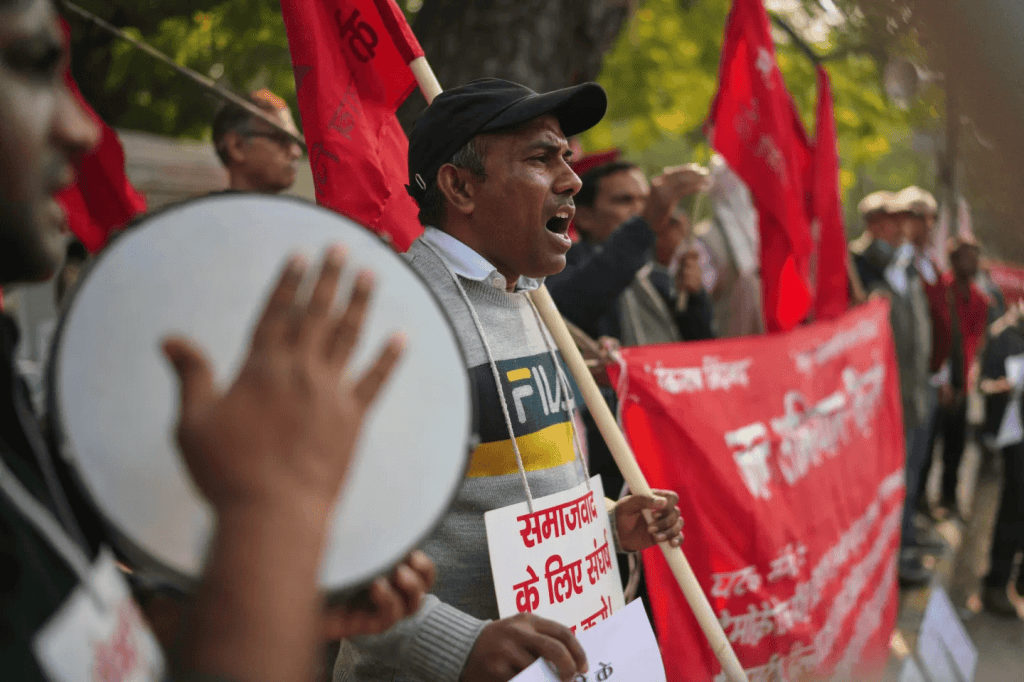
India’s labor laws abruptly changed on Friday, November 21, 2025 when the Hindu nationalist Prime Minister Narendra Modi announced that their “modernization” would proceed. In response, over 10 national trade union federations announced that they would mobilize on Wednesday, November 26, against the implementation of these changes.
India’s labor history dates back over a century, with some of the earliest trade unionism led by Narayan Meghaji Lokhande, who organized cotton mill workers and other textile workers. The Bombay Millhands Association was the first labor union in India, founded in 1890 under British colonial rule. Over the subsequent decades, the growth of the trade union movement led the British government to respond with the Trade Union Act of 19261. This act formalized the process by which a union could become legally recognized. Notably, it left the implementation of union registration up to state governments.
With the continued growth of the trade union movement, the communist movement, and the anti-colonial movement during this period, the eventual Constitution of India enshrined the right to unionize in its text2. While subsequent governments have worked their hardest to restrict the ability for workers to unionize, the fundamental right to form unions in the Constitution has been a thorn in their side that the Indian ruling class has had to deal with since their transfer of State power from the British in 1947.
With over a century of labor laws and acts, the Indian government in 2019 began creating four new labor codes that would supersede all prior laws on the matter. These four codes are the Labour (Wage) Code, the Industrial Relations Code, the Social Security Code, and the Occupational Safety, Health, and Working Conditions (OSHW) Code. These codes were passed over the period of 2019–2020, yet their implementation was delayed by years. Firstly, this was due to the requirement that both the federal and state governments had agreed upon rules for implementing these codes3. Secondly, the Joint Platform of Central Trade Unions (JPCTU) presented significant disagreements with the codes, especially the Industrial Relations Code. They called for a general strike in March 2022, which led to the delay of the codes’ implementation4.
While the government maintains that these codes simplify and modernize labor laws, and promote them as progressive, this is clearly not the case. The Wage Code does not define the minimum wages, leaving this to be determined by the federal government. Given the fact that the Indian Old State works in service of imperialism and the Indian bureaucrat capitalists, this minimum wage is likely to be very low. The Wage Code also provides numerous exceptions for when wages can be deducted from workers5. Prior laws required workers employed through contractors to be payed even if the contractor/subcontractor does not6, yet the new Wage Code contains no such provisions. Given the high rate of contract labor usage in the Indian workforce, this clearly allows employers to make use of questionable subcontractors and not be required to pay their workers at all.
The Industrial Relations code raises the required number of employees for regulations to apply from 100 employees to 300 employees7. This is a clear attempt to deregulate the hiring and firing of Indian workers, which will ultimately increase the power of Indian capitalists relative to workers. Strikes are now tightly regulated. Workers must give sixty days notice to employers of a strike, and cannot strike for fourteen days after such notice is provided8. Additionally, the Code also mandates that only a single union shall have the right to negotiate with an employer in a workplace, either representing at least 30% of all workers (in the case of a sole union), or representing at least 51% of all workers (in the case of multiple unions in a workplace)9. If no such unions exist, the employer is allowed to create a “negotiating council” between itself and all such unions with at least 20% of their workforce.
Ultimately, all these changes demonstrate the intent of the Indian Old State to consolidate their seizure of power away from workers and into the hands of capitalists. The hard-won labor rights of over a century ago are now being done away with, and in their stead is a series of capitulations given straight to employers. While this is being framed as a “modernization” and a guarantee of “workers rights,” it is clear that all these new benefit schemes being guaranteed to workers are just another way for employers to end up paying less. While India used to have a much lower debt to GDP ratio, over the last several decades it has risen steeply, being over 80% in the last 5 years.10 This rise parallels the neoliberalization and transformation of India’s economy in favor of capitalists and at the expense of the working class. These Labour Codes, being passed from 2019–2020, likely served to reduce this ratio. Their forestallement for five years was in tandem with a record high debt to GDP ratio, and it is clear how their sudden implementation now serves to weaken the working class to increase exploitation, which will ultimately serve to make the Indian economy more “productive” and pay off debt.
In general, there is a global trend of “reforms” to labor laws which do not serve workers but instead serve capitalists and the state. In parallel to India’s ongoing changes, in the US has also had a series of “reforms” to its labor laws which have only worked to sell out the political interests of the working class. The National Labor Relations Act, the Taft-Hartley Act, and later “Right-to-Work” laws, all have served to create an officially-sanctioned set of unions which operate for the interests of the petit bourgeoisie, the large bourgeoisie, and the US State. In an even more direct connection, some contemporary US politicians such as Vivek Ramaswamy, who support India’s Prime Minister Narendra Modi,11 have been directly praised by US state unions for his support of reactionary labor laws!12
There is no shortage of sellouts to the Indian working class in the country’s labor history. In 1962, during and after the Sino-Indian border war, Shripad Amrit Dange completely sided with the Nehru government in India. Dange was at the time the chairman of the Communist Party of India and the General Secretary of the All-India Trade Union Congress (AITUC). In the four days after the Indian attack on the Chinese border, Nehru called for Indian workers to “not indulge in strikes.”13 Dange proposed that the AITUC, Indian capitalists, and the Indian State meet together and discuss their problems. This meeting ended with a resolution that prohibited Indian workers from striking or stoppages or slow-downs, and pushed them to contribute financially to “national defense.”14 This level of collaboration between unions, capitalists, and the state (sometimes called corporatization) is exactly what the present Indian State aims to push for through the new Labour Codes.
In this context, on November 26, 2025 a strike called by the Joint Platform of Central Trade Unions15 occurred in response to the implementation of the Labour Codes. Some estimates say that hundreds of thousands of workers struck that day,16 although this is in a country of around 1.4 billion people.17 It begs the question what a one-day strike of a relatively small percentage (about 0.01%) of the population accomplishes politically? The Labour Codes remain, and there is no sign that they will be rescinded. It is clear that none of the ten central trade unions are able to carry out any semblance of protracted action. What differentiates the Joint Platform members from the Bharatiya Majdoor Sangh (BMS)? The BMS is a fascist union affiliated with the Rashtriya Swayamsevak Sangh (RSS), the paramilitary organization that the BJP is also affiliated with. The BMS has also agitated against the Labour Codes,18 and presented much of the same criticisms as the Joint Platform members have. Both the BMS and the nominally “Communist” or “progressive” trade unions of the Joint Platform of Central Trade Unions all share a fundamental Economism in their work, which only serves the Indian bourgeoisie and state.
The reality is the Indian and American labor movements suffer from the same problems. The largest union centers in both countries rely mainly on the patronage of the bourgeois state instead of on mobilizing the poorest sections of the working class. The officials of both movements are tied to the major capitalist parties in each country and follow a similar practice of picketing for reforms to existing labor law. When the masses do strike, the officials channel it into aimless protests if not outright sabotage them in order to shield themselves from government persecution. In fact, not only do the reactionary elements of the labor movement predominate in both countries, but in both cases they are supported by the reactionary and revisionist parties. While India is much poorer than the US in terms of GDP per capita, and is a semi-colonial nation, this has not prevented the country from having a similar arrangement of class forces in the labor movement: a huge mass of poorly paid wage workers remains unorganized, and the minority who are organized are held hostage by the labor bureaucrats which in turn relies on the concessions offered by imperialism, in this case because of comprador and bureaucratic capitalism. In both cases, class struggle is the key link: everything in the labor movement hinges on it. Embracing reformism and picking at the fringes of labor law has been shown in both countries to be a fruitless strategy.
In both the US and in India, there is a pressing need for independent trade unionism to grow and develop into a powerful and combative force to fight for the political and economic demands of the working class. As can be seen by the ability of the Indian State to push these Codes through to law, and the weak and short-lived response of the Joint Platform of Central Trade Unions, there is only so far that reformist unionism can take workers.
1) https://www.indiacode.nic.in/bitstream/123456789/13322/1/trade_unions_act_1926.pdf
2) https://indiankanoon.org/doc/1218090/ Article 19 (1.c)
3) https://www.hindustantimes.com/india-news/indias-sweeping-labour-code-implementation-stalled-until-2024-elections-101683485041321.html
4) https://www.facebook.com/CITUHQ/posts/press-release-28th-march-2022the-countrywide-general-strike-on-the-first-day-wit/4997147870370376/
5) https://labour.gov.in/sites/default/files/the_code_on_wages_as_introduced.pdf Chapter III, Section 18
6) https://www.indiacode.nic.in/bitstream/123456789/12922/1/the_payment_of_wages_act%2C_1936_no._4_of_1936_date_23.04.1936.pdf (3)(2)
7) https://labour.gov.in/sites/default/files/ir_as_passed_by_lok_sabha.pdf Chapter IV (28)
8) https://labour.gov.in/sites/default/files/ir_as_passed_by_lok_sabha.pdf Chapter VIII
9) https://natlawreview.com/article/india-s-new-labor-codes-concept-negotiating-union
10) https://tradingeconomics.com/india/government-debt-to-gdp
11) https://ddnews.gov.in/en/vivek-ramaswamy-calls-meeting-with-pm-modi-a-pleasure-and-honour-after-bilateral-talks-in-washington/
12) https://www.cleveland.com/open/2025/11/labor-lining-up-with-ramaswamy-illustrates-how-a-democrat-base-of-support-has-shifted.html
13) Documents of the CPC Great Debate Vol 1 page 470
14) Documents of the CPC Great Debate Vol 1 page 471
15) Which has membership from the Indian National Trade Union Congress (INTUC), All India Trade Union Congress (AITUC), Hind Mazdoor Sabha (HMS), Centre of Indian Trade Unions (CITU), All India United Trade Union Centre (AIUTUC), Trade Union Coordination Centre (TUCC), All India Central Council of Trade Unions (AICCTU), Self Employed Women’s Association (SEWA), Labour Progressive Federation (LPF) and the United Trade Union Congress (UTUC).
16) https://peoplesdispatch.org/2025/11/28/hundreds-of-thousands-protest-anti-labor-legislation-in-india/
17) https://www.pib.gov.in/PressReleasePage.aspx?PRID=2106921®=3&lang=2
18) https://www.hindustantimes.com/india-news/indias-sweeping-labour-code-implementation-stalled-until-2024-elections-101683485041321.html
 newlaborpress.org