“Unity, struggle or even splits, and a new unity on a new basis — such is the dialectics of the development of the international working-class movement… Anyone who follows a programme and line running counter to the revolutionary will and fundamental interests of the proletariat and the working people is a splitter.”1
The labor movement has gone through innumerable splits on the international and national scales since the founding of the International Workingmen’s Association in 1864. However, in the 20th century, a split took place beginning in 1956 that had never happened before: the socialist camp, which had firmly been built up and consolidated over the course of two world wars, was divided into two. One camp, led by the Communist Party of the Soviet Union, restored capitalism by placing profit in command of state and collective enterprises and replaced class struggle and the dictatorship of the proletariat with the “state of the whole people” led by the “party of the whole people”. The other camp, led by the Communist Party of China, deepened the experience of the international proletariat in its struggle against capitalist restoration in a socialist country through the experience of the inner-party struggle against revisionism and the Great Proletarian Cultural Revolution. This was nothing new insofar as the question of which class will hold state power has always been the central issue in politics. In relation to the international labor movement, what the Sino-Soviet Split did accomplish was it once again forced a re-examination of the activities of the existing trade union organizations and provided positive and negative experience regarding the role of the trade unions within the dictatorship of the proletariat.
The Split Foreshadowed and the Struggle in the CPC
As soon as the workers and peasants seized state power on a national scale for the first time in the October Revolution in 1917, the opportunists within the Communist Party of the Soviet Union immediately set to work advancing theories intended to weaken the new state power (based on the worker-peasant alliance represented by the Soviets) and replace the leadership of the proletariat with their own factional leadership. This early conflict over the trade unions was enshrined in Trotsky’s opportunist pamphlet “The Role and Tasks of the Trade Unions” and exposed by Lenin in “The Trade Unions, the Present Situation, and Trotsky’s Mistakes” and “Once Again on the Trade Unions.” Lenin explained that, “[Trotsky] seems to say that in a workers’ state it is not the business of the trade unions to stand up for the material and spiritual interests of the working class. That is a mistake.” And concerning his method in analyzing the trade unions, Lenin criticized Trotsky for his, “out-and-out bureaucratic approach. The whole point, you see, is not the level of development and living conditions of the masses in their millions, but the ‘spirit’ which Tomsky and Lozovsky tend to cultivate ‘in their midst’… Is it that someone has refused to understand the “new tasks and methods”? Or is it that someone is making a clumsy attempt to cover up his defence of certain useless and harmful excesses of bureaucracy with a lot of talk about new tasks and methods?” Thus, even before the Sino-Soviet split, opportunists in the socialist camp wanted to convert the trade unions into a bureaucratic appendage of the state which does not concern itself with the interests of the working-class.
No surprise, then, that this issue appeared in the CPC not long after its victory throughout mainland China. A Peking Daily editorial described the inner-party struggle over the trade unions in this way: “They [Chinese revisionists in the trade unions] abandoned class struggle, opposed the dictatorship of the proletariat and the putting of proletarian politics to the fore, tampered with the class nature of the trade unions and opposed Party leadership. They energetically ran ‘trade unions for production,’ ‘welfare trade unions’ and ‘trade unions of the entire people’ and pushed syndicalism…. Under the dictatorship of the proletariat, the struggle between the two lines in the workers’ movement focuses on whether or not class struggle is taken as the guiding principle for the workers’ movement. … He [Liu Shao-Qi, “China’s Khrushchev”] fanatically advocated that the Party ‘can only assist, but not exercise leadership over’ the trade unions, and repeatedly stressed that the trade unions should establish an independent ‘systematic leadership.’ Shielded by China’s Khrushchev and following him step by step, the handful of persons in authority taking the capitalist road who entrenched themselves in the All-China Federation of Trade Unions advocated ‘the independence of trade unions,’ They blustered that the trade unions should be ‘on a par’ with the Party and should not be ‘directed commanded and interfered with’ by the Party but should have their own ‘systematic leadership.’ China’s Khrushchev and his agents in the All-China Federation of Trade Unions babbled that while the Party ‘includes only the advanced section of the working class,’ the trade unions ‘embrace almost all members of the working class and they can be described as the ‘basic contingents’ of the working class.’ Therefore, ‘it cannot be said that the Party can give leadership, while the working class cannot.’ China’s Khrushchev and his agents even demanded that the trade unions assume ‘daily growing’ importance in ‘implementing the duties of state organs’ and ‘supervise’ the government. In line with these reactionary theories, they turned the trade unions into an anti-Party “independent kingdom” and hoped to replace the Party with trade unions, in a futile attempt to realize their criminal counter-revolutionary aim of usurping Party and state power. After this whole set of syndicalist fallacies were criticized and rejected, China’s Khrushchev could not but change his counter-revolutionary tactics and in 1958 he put forward the slogan that the trade unions should serve as a ‘docile tool’ of the Party. This was a scheme to keep the trade unions firmly under the control of the bourgeois headquarters of China’s Khrushchev to serve as a counter-revolutionary tool for opposing Chairman Mao’s proletarian revolutionary line. It is common knowledge that, neither in capitalist society nor in socialist society, is there any kind of trade union independent of a political party. The trade unions accept the leadership either of the political party of the proletariat or of the political party of the bourgeoisie. This is an objective law of class struggle, which is independent of man’s will.”2
We can see then how the battle between the socialist road and the capitalist road in China played out fiercely in the trade unions as well. This battle focused on the questions of whether trade unions should serve as instruments of class struggle or instruments of controlling the workers and increasing production, of political leadership, and of the state and political power.
The revisionist line cannot be reduced to a single erroneous formula or scheme. On the contrary, like all varieties of opportunism, the revisionists adapt themselves to whatever serves their short-term interest. If the revisionists have consolidated within the ruling party, then they will uphold the unions as “docile tools” of the party and state. If they have consolidated themselves within the trade union officialdom, they will advocate the “independence” of the unions and use them as a tool against the party and state. The central tenet of revisionist policy in the trade unions is opposing putting politics first and turning them from organizations of wage workers engaged in class struggle into organizations for maintaining efficiency, production, or welfare standards. This is wrong in principle because these factors are themselves determined by the class struggle. Production standards, efficiency, and the welfare of the workers are directly connected to exploitation. Either the trade unions defend the political and material interests of the workers, or they do not; this is the fundamental criteria for assessing any trade union.
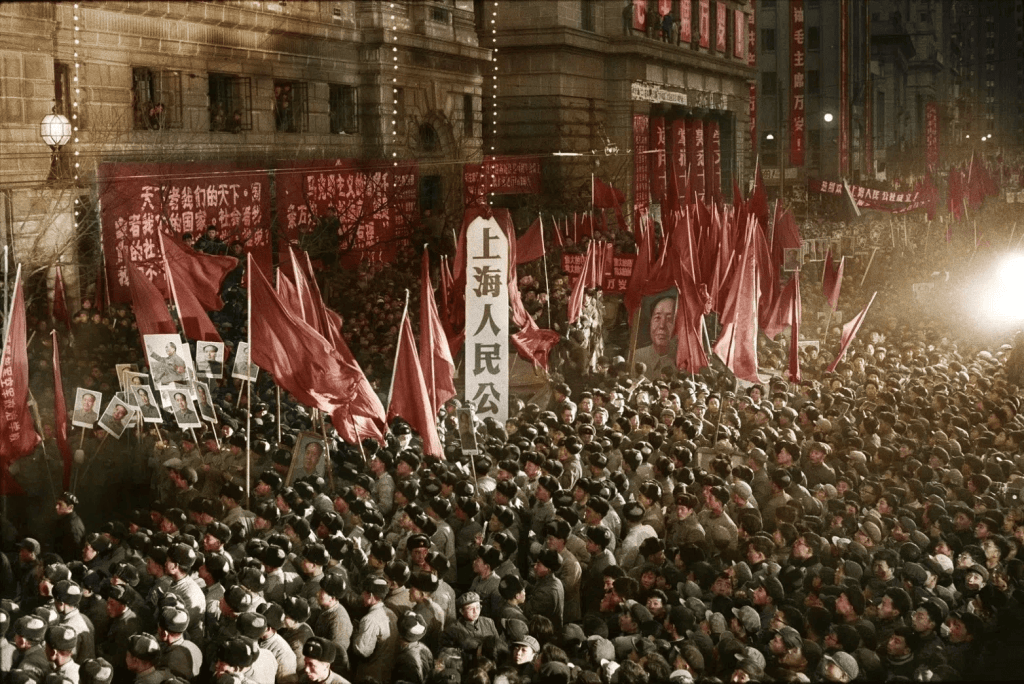
This became a major point of contention during the Cultural Revolution, for example, during the emergence of the Shanghai Workers’ Revolutionary Rebels General Headquarters, or Worker’ General Headquarters (WGH) for short. The WGH emerged in Shanghai among the cities industrial workers following the rise of the student Red Guards in Beijing. Lead by Wang Hongwen3, the WGH clashed with the establishment trade union leadership, who were concerned about the workers’ democratically organizing on the shop floor without authorization and thus disrupting production. In this way, through the leadership of Chairman Mao and Communist Party of China, during the Cultural Revolution the masses took the revolutionizing of the labor movement and workers’ mass organizations to new unexplored heights, while the Soviet labor movement fell back into the old reactionary pattern of a fascistic, undemocratic, and class-collaborationist trade unionism.
The Role of the Revisionist Trade Unions in Defending and Restoring Capitalism
In 1956, the Twentieth Congress of the CPSU signaled the rise to power of revisionism in the Soviet Union on the grounds of combating Stalin’s “personality cult”—meaning in actual fact combating the ideology and leadership of the proletariat. The Soviet revisionists summed up their policy in the “state and party of the whole people” and the “three peacefuls”, meaning peaceful transition to socialism, peaceful competition with capitalism, and peaceful coexistence with imperialism. This policy was a renunciation of the dictatorship of the proletariat and the struggles of the workers and oppressed nations against imperialism.
However, a leadership coup alone does not restore capitalism. The Soviet revisionists needed to completely reorganize the economy and civil society in order to successfully compete with US imperialism for profits. Naturally, this could not be accomplished without the participation of the working-class, and to this end the trade unions were mobilized. Filip Kota of the Party of Labour of Albania (then allied with the CPC) characterized the revisionist Soviet trade unions in the period of capitalist restoration like this:
“The functions of the trade unions have also undergone a radical change: their political and educational role has been replaced by economic, as general line…. An important task in applying this reform has been assigned to the revisionist trade unions, which make a fetish of material stimulus and consider it to be ‘a very strong weapon’ and a ‘new, effective instrument.’ This line goes so far as to seek to replace educational work with material stimulus. … Class differentiation in the Soviet Union and the other revisionist countries is now a well-known reality. The new bourgeoisie, among others, includes the trade union bureaucracy and the new worker aristocracy. From the ideological and economic point of view, this stratum has detached itself from the working class and the interests it upholds, from the base; it opposes the working class, and. with the aid of the state, exploits and oppresses it and all the working people. Within this context, the function of the trade unions is to supervise, keep in submission and curb the working class, to suppress the inevitable class conflicts, and to break its revolutionary spirit. … In revisionist countries, the trade unions base their activity on the work of the trade union functionaries, who make up a bureaucratized ‘elite.’ The principle of active work in society has been replaced by that of the closed, confined work of the bureaucratic trade union apparatuses, which impose themselves above the elected organs and decide everything. This method of work led to a situation in which the trade union organizations at the base in the revisionist countries were no longer motivated by a spirit of militancy, but were characterized by the general indifference and apathy of the masses of its members towards various problems. The trade unions were turned into a formal organization without vitality and vigour. In explaining why he gave up being a member of the trade union committee of his work center, a Soviet worker wrote, in a letter to the newspaper ‘Trud’ dated November 13, 1969: ‘The fact is that our trade union organization exists only formally, on paper. In fact, no work is done in it. It has neither standing nor temporary commissions.’ Nor is this an isolated case.”4
We can see then how over the course of capitalist restoration in the Soviet Union, the trade unions had been transformed into their opposite. Whereas once they were instruments of class struggle and class organizations of the proletariat, they were now instruments of class collaboration controlled by the bourgeoisie. This passage could easily describe any of the largest American unions over the last several decades. Officials acting as nothing more than extensions of the government and who have no support among the workers and simply do not organize them in any sense are common in the contemporary labor movement.
Curiously, Brezhnev’s own description of the Soviet revisionist trade unions is virtually a condemnation of them: “Our trade unions are operating in a society in which socialism has won the day and their main features are determined by this fact. In their struggle for the interests of the working people they have progressed beyond the ‘protective function’, because our country has long since been rid of any exploiting classes… One of the main features of the Soviet trade unions is that they take a direct and active part in the development of society, in raising production, increasing its efficiency and in economic management. The trade unions possess quite a number of well-tried means of influencing this decisive sphere of social life. First among these comes the trade unions’ ability to organise socialist competition… [the competition movement in the trade unions] must orientate the masses of the working people to strive for quality as well as quantity and the saving of funds, of material and labour resources, for the effective and rapid incorporation in production of scientific and technological advances, for increased labour productivity.”5 Brezhnev sees the class struggle as a thing of the past—hence it makes sense to convert the trade unions into an appendage of the state responsible for maximizing “efficiency” (meaning profit, which was put in command of economic planning under the Kosygin reforms) and overseeing competition among the workers for bonuses and the like. This has nothing to do with Marxism, and in fact more closely resembles the “efficiency unionism” that was popular in our own country in the American Federation of Labor in the early 20th century. This policy was deliberately fostered by the bourgeoisie in the American labor movement in collaboration with the openly pro-capitalist AFL officials.
However, the revisionist line was not only applied in the Soviet Union. It was also applied in countries where the bourgeoisie was still formally in power, such as France, where the revisionist unions sold out the fundamental interests of the workers for meager concessions. Most notoriously, the French Confédération Générale du Travail worked to isolate the workers from the mass student movement during the crisis of May 1968. The Chinese analyzed this mass uprising of strikes and student walkouts and factory and school occupations from the standpoint of the class struggle in the mass movements:
“In an effort to maintain its tottering reactionary rule, the French monopoly capitalist class has gone all out in its counter-revolutionary two-faced tactics—political deception and violent suppression. On the one hand, it staged its disgusting ‘election’ farce and made empty promises of ‘reforms’ and trivial concessions in wage and welfare benefits to deceive the people. On the other hand, it flagrantly sent police, special agents, gendarmes and security forces all over the country to carry out bloody suppression of the students and workers… The revisionist leading clique of the French Communist Party and the bosses of the General Confederation of Labour (C.G.T.) under the control of the French revisionists openly came out for maintaining the ‘law’ and ‘order’ of the bourgeoisie at a time when French ruling circles were in the grip of a grave crisis. They spared no effort in attacking and undermining the just struggles of the students and workers. This has fully revealed their ugly features as renegades and scabs who play the role of watch-dogs of the imperialist and capitalist system of exploitation. The French revisionist chiefs mortally hate and fear the students who were the first to rise in struggle. As apologists for the reactionary authorities, these revisionists have once and again attacked and slandered the students who are carrying out a just struggle as ‘provocative elements’ and ‘creating revolt’. At a time when the masses of French workers has broken through the obstacles put up by the revisionists and had launched an irrepressible wave of occupying factories and holding strikes throughout the country, which was like a big earthquake shaking the very rule of the monopoly capitalist class, these revisionist chiefs lost no time in reaching ‘agreement’ with the government and the capitalists on resumption of work at the expense of the workers’ fundamental interests.”6
In the nominally-socialist revisionist countries, the revisionist unions carried out the same tasks but on a higher level. While the CGT in France defended capitalist rule in exchange for a minor hit to capitalist profits, the Soviet revisionist trade unions actively worked to maximize capitalist profits. In both cases, the class struggle in the labor movement continued with no regard for the illusions of the revisionist leaders. The choice put before the millions of wage workers was to follow the revisionist union leaders down the capitalist road of oppression and exploitation or organize on behalf of their own fundamental political interests.
Conclusion
The bourgeois intellectuals and revisionists try to paint the Sino-Soviet split as a personal conflict between the Khrushchev clique and Mao, for their own ideological reasons. The fact is, however, that this split took place on an international scale and brought to the forefront issues which touch every labor organization across the globe. Khrushchev and Mao have both been dead for decades, yet this split in the labor movement has only become more acute, with the revisionist union bosses and scabs openly integrating into the bourgeois state apparatus as well as collaborating with the U.N. organs and capitalist parties and even merging with some capitalist organizations such as the Chambers of Commerce (in the US) and sharing in the plunder of the imperialist mutual funds and buying Israeli bonds.
Far from being an obscure academic debate, the Sino-Soviet split actually demonstrated in practice what the different lines on the trade unions lead to. The revisionist line, which bases itself on economics (production efficiency and incentives) instead of the class struggle, can only hasten capitalist restoration and strengthen existing capitalist rule. There should be no mystery as to where this line leads more than thirty years after the formal renunciation of socialism and the destruction of the Soviet state. The Maoist line, which bases itself on the scientific fact that “class struggle is the key link and everything else hinges on it”, in contrast, puts the onus on the trade unions to organize the masses of working people to advance their fundamental political interests.
Every labor organizer today must apply Mao’s advise for cleaning up the labor movement: “Draw a clear line of distinction between the working class and the bourgeoisie, and in trade unions eliminate corruption and bureaucracy which alienates the masses and weed out the capitalists’ hirelings. Such hirelings and the middle elements vacillating between labour and capital are to be found in trade unions everywhere, and in the struggle we must educate and win over the middle elements, whereas those hirelings guilty of serious crimes should be expelled.”7 Without fierce line struggle, it is impossible to unite the majority of workers and oust the reactionary elements in the labor movement that have led it to its current backwards state. The class struggle in the labor movement is the key link, everything hinges on it: the current state of disorganization and poor working conditions in the US will not be overcome until the proletariat is victorious over the bourgeois lackeys of the state unions. The Sino-Soviet split represented the beginning of this struggle on the international plane, and today is continued in the American labor movement between the anti-imperialist NLOC and the revisionist organizations who want to do socialist phrasemongering from within the pro-capitalist state unions.
Further Reading
It is worth studying Li-Li San’s description of the Chinese trade unions following liberation: “Whenever a city is liberated and the working class has changed from its former brutally oppressed position as a slave into the master of society and the State enjoying all free and democratic rights, the primary task of the trade unions is to educate the workers, arouse their class consciousness, and organise them to cooperate in taking over the enterprises originally in the hands of bureaucratic capital.” from “Report on Trade Union Movement in China”, 1949, retrieved from https://revolutionarydemocracy.org/archive/LiLiSan.pdf
*“One out of every five people in France was drawn into the ‘contingents of fighters’ at the height of the raging storm of the nationwide general strike, launched on May 17 and continuing for some four weeks. In the battle against French monopoly. capital, progressive students and revolutionary workers consistently fought shoulder to shoulder against the common enemy. The French revisionist leading group and the scab union bosses who joined together with the money bags were consistent too—in their shameless sell-out of the interests of the working class. Working overtime for the reactionaries, these traitors to the French working class did their best to hamper and wreck the militant solidarity between the workers and students. In its June 7 statement, the General Confederation of Labour, which is controlled by the French revisionists, vehemently attacked the Paris students who, brushing aside all difficulties and risks in their hurried march to Flins, fought side by side with the workers who had been brutally driven out of their factories by the security forces. The C.G.T. maligned the students as ‘acting on behalf of the worst enemies,’ and ordered the striking workers to toe the C.G.T. line and not to listen to the suggestions of the students. In a thousand and one ways, it tried to undermine the jointly conducted courageous worker-student struggle against the rotten capitalist order.” [Peking Review, #25, June 21, 1968, pgs 21-2, retrieved from https://www.marxists.org/subject/china/peking-review/1968/PR1968-25.pdf]
*“For the past month, a great storm of the French revolutionary mass movement has been sweeping the whole of France. The last few decades have not witnessed in France a movement so large in scale, so dynamic in force, so rapid in growth and so sharp and sustained in its struggles, or such a steadily growing merger of the students’, workers’ and peasants’ movements… One can see that running through this great storm is a bitter struggle between the two basic stands, two roads and two lines represented on the one hand by the French revolutionary Marxist-Leninists [pre-Maoism] and on the other by the inveterately treacherous modern revisionist clique of the French Communist Party.” [Peking Review, #24, “Old Scabs, New Betrayal—A Denunciation of the French Revisionist Renegade Clique”, June 14, 1968, retrieved from https://www.marxists.org/subject/china/peking-review/1968/PR1968-24.pdf ]
*“The struggle between the proletariat and the bourgeoisie and between the socialist road and the capitalist road continues throughout the whole socialist period. The trade unions, therefore, must persist in taking the class struggle as the key in all work, promote production by carrying forward the revolution, consolidate the proletarian dictatorship and fulfill their role as a pillar of the proletarian dictatorship. In steadfastly taking the class struggle as the key to their work, our trade unions must educate and organize the masses of workers and employees to take their place in the forefront of this class struggle, see the situation and the characteristics of class struggle clearly, and resolutely combat all activities of capitalism and other reactionary forces that are trying to stage a come-back.” [Peking Review, #20, “Militant Role of China’s Trade Unions”, republished from Gongren Ribao, May 14, 1965, retrieved from https://www.marxists.org/subject/china/peking-review/1965/PR1965-20.pdf ]
Article Sources:
1“The Leaders of the CPSU are the Greatest Splitters of our Times”, Renmin Ribao editorial
2) Peking Review, “The Struggle Between the Two Lines in China’s Trade Union Movement”, June 28, 1968, retrieved from https://www.marxists.org/subject/china/peking-review/1968/PR1968-26.pdf, emphasis added
3) A worker of the Number 17 Cotton Mill who would eventually go on to organize the Shanghai People’s Commune and become a member of the Left Line and upper leadership of the Communist Party of China
4) Two Opposing Lines in the World Trade Union Movement, 1974, pgs. 53-56
5) Brezhnev, “The Decisions of the Twenty-Fourth Congress of the CPSU…”, retrieved from https://www.marxists.org/archive/brezhnev/1975/followingleninscourse1975.pdf]
6) Peking Review, #28, “A Splendid New Page in French History”, July 12, 1968, retrieved from https://www.marxists.org/subject/china/peking-review/1968/PR1968-28.pdf, emphasis added]
7 “On The Struggle Against The ‘Three Evils’ And The ‘Five Evils’”, retrieved from https://www.marxists.org/reference/archive/mao/selected-works/volume-5/mswv5_17.htm]
 newlaborpress.org