Two years ago, the combined might of the forces for Palestinian national liberation in Gaza launched a heroic counteroffensive against the Israeli occupation forces. Since then, the state of Israel, with the backing of the ruling class of the West, has intensified its genocidal campaign against the Palestinian people. In the typical imperialist fashion of “lifting a rock only to drop it on one’s own feet,” in response to their brutal actions, tens of millions of working and oppressed people around the world have risen in defense of Palestine, and a new generation of revolutionaries has emerged, inspired by the Palestinian resistance. However, amid this surge against Western imperialism, many new to the struggle, unfamiliar with the U.S. labor movement, have asked: Where are U.S. trade unions in this fight? Of course, as those of us experienced from years in the workplace struggle know, since its inception in the late 1800s and to this day, the establishment labor movement in the US has been a crucial force in the expansion and sustenance of US imperialism. As former AFL-CIO president George Meany openly stated, “there is no other single organization in the world which has supported the state of Israel more, financially and morally, than the AFL-CIO and its affiliates.”
However, it does not have to be this way; workers in the United States can join with the ranks of workers across the world in delivering direct blows to US imperialism by launching strikes and taking action against the supply chains that fuel Israel’s genocidal campaign against the Palestinian people. In fact, workers in the United States have done it before. In 1973, in Detroit, Michigan, the place President Franklin D. Roosevelt dubbed the “Arsenal of Democracy” for its significance to American imperialism, 2,500 rank-and-file auto workers in opposition to their union leadership, went on strike in support of Palestine.
In the late 1960s, due to political struggles brought on by immense exploitation from imperialist powers, tens of thousands, particularly from Palestine, Yemen, and Lebanon, immigrated from the Middle East to the United States, moving to Detroit, where a small Arab community already existed. Upon arriving, many found work in Detroit’s immense auto-manufacturing industry. In 1968, 500 Arab immigrants worked at Chrysler’s Dodge Main plant; by 1974, that number would balloon to over 2,000. In the auto industry, Arab immigrants faced constant racism and xenophobia both from the company and the overwhelmingly white UAW union bureaucrats. Arab workers were placed on the most gruesome, tiring, demanding jobs and had to navigate language and cultural obstacles.
Developing at the same time as the influx of Arab workers to Detroit’s auto plants was a great surge of struggle by Black workers against police brutality, white supremacism, and similarly awful working conditions. The spark to this was the 1967 Detroit Uprising, which remains one of the most militant mass uprisings the US has ever seen. In the aftermath of the rebellion, many organizations would be set up; however, none would go on to be as impactful as the Dodge Revolutionary Union Movement (DRUM), which would organize thousands of Black Detroit autoworkers in several wildcat strikes against both Chrysler and the racist UAW union leadership. Their successes would inspire many workers, and throughout the next two years, more than a dozen RUMs would be developed, consolidating into the League of Revolutionary Black Workers, which would direct the militant rank and file shopfloor upsurge. From its inception, the LRBW, guided by Marxism, would apply the principle of internationalism, drawing links between conditions at home and struggles abroad. In 1968, League leader John Watson was resoundingly attacked by Wayne State University, along with City, state, and union officials, when he published an article in support of Palestinian guerrillas in the student-run newspaper “The South End.” Several years later, in 1973, Watson would eventually travel to the Middle East and meet with Palestinian resistance fighters.
In turn, understanding that their struggle against capitalism, white supremacy, and imperialism was directly linked to that of Black workers, many Arab workers honored wildcat strikes organized by the League and its affiliates. One autoworker wrote in Spark, a rank-and-file shop paper, that “Chrysler figures that no one will try to help an Arab worker when Chrysler attacks him. So now Chrysler is attacking…It’s the same kind of shit they have pulled with Black people.” Inspired by the successes of the League and also the 1968 Battle of Karameh, where the Palestinian Liberation Organization won its first military victory over the Israeli Defense Forces, Detroit’s Arab workers began to organize on the shopfloors and in their communities. Echoing DRUM five years earlier, in 1973, the Arab Workers’ Caucus (AWC) was formed, consolidating the various spontaneous organizing efforts. The AWC soon spread to twenty different auto factories in the Detroit area. The AWC was a rank-and-file organization that opposed not just the miserable conditions on the shopfloor but the xenophobic and racist UAW bureaucrats, along with the unions’ and the big three automakers’ General Motors, the Ford Motor Company, and Chrysler’s increasing investments in Israel. They also did not just organize among Arab workers, but made efforts to build links with all workers, but especially Black workers.
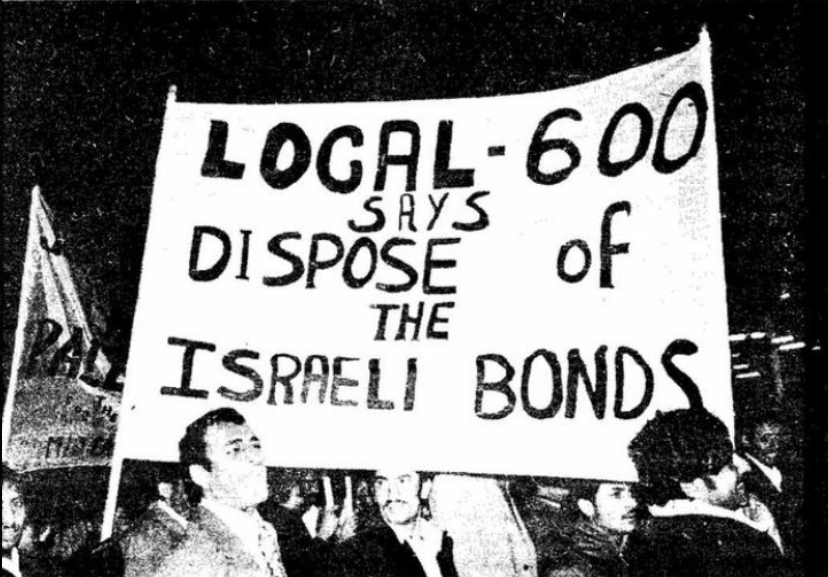
In 1973, the Arab-Israeli War erupted, and many local Arab workers learned that UAW Local 600 had used their dues money to purchase $300,000 in State of Israel bonds. In response, three thousand autoworkers and community members marched on the local on October 13th, demanding the bonds be terminated. Determined and energized, seventy representatives from nearly every auto plant in Detroit gathered to form the Arab Workers’ Caucus. The group set its eyes on November 28th, when UAW International president Leonard Woodcock was soon set to appear in downtown Detroit to be honored by B’nai B’rith International, a Zionist charity organization, with its Humanitarian of the Year award. Knowing that the racist local union officials would be in opposition to their action, the AWC planned to organize a wildcat strike without concern for the union bureaucrats. To accomplish this, they worked with local high school students and community members to distribute 70,000 leaflets calling people in Arabic and English to join the wildcat. In addition, the organization also coordinated with former elements of the League of Revolutionary Black Workers, which had split two years prior, such as Jerome Scott.
On the day of the strike, high school students stationed themselves outside the gates of Dodge Main, one of Detroit’s largest automobile factories, they informed all coming and going workers of the strike. When the call to strike finally came, over 2,5000 workers laid down their tools and walked out. Production at Dodge Main was completely halted for the day, and several other auto factories experienced major slowdowns. That night, when UAW president Leonard Woodcock was being awarded at the $100-a-plate B’nai B’rith dinner attended by both the mayor of Detroit and the chair of General Motors, 1,000 mostly Arab autoworkers and their Black coworkers picketed outside the event. They were joined by revolutionary organizations such as the Communist League and Revolutionary Union. Leonard Woodcock, fearing facing the crowd made up of his own union’s rank and file, was forced to sneak out of a back door. UAW secretary treasurer Emil Mazey claimed the strike was a “communist conspiracy” and contended that the union’s use of members’ dues money to purchase Israeli bonds was simply a good investment for the union. 500 strikers at Dodge Main would receive disciplinary notes from management, and the union refused to defend the strikers. Undeterred, the AWC continued organizing, labelling UAW bureaucrats as sell-outs in the same vein as Middle Eastern leaders who give in to US imperialism. After a failed attempt to rally support for a program at the 1974 UAW constitutional convention, the AWC continued to organize among the rank and file and pressed demands at the local level, resulting in the liquidation of $48,000 in Israeli bonds by 1975.
While the momentum of the 1973 Detroit Strike for Palestine was short-lived, it is an important lesson today for all those struggling against Zionism and imperialism. In particular, that even on a local level, workers, when organized on the shopfloor, have the unique ability to deliver direct blows to US imperialism. However, this can only be done by workers getting organized and taking action outside the existing leadership and structure of the state unions. We must impose a proletarian political line in the workers movement that centers the struggle to overthrow imperialism generally and to combat U.S imperialism and its proxies, like Israel, particularly. The state unions and their leaders in the United States directly materially benefit from the exploitation of workers across the world. The biggest threat to US imperialism is the construction of an independent, combative, class against class labor movement. This is why the full weight of the US capitalist machine is put into working against the working class getting organized. However, today, Brazilian, Filipino, and other workers around the world are proving every day by example that independent unions can contend directly with the labor organizations of the ruling class. It is our task as workers in the United States to link up with the emerging militant and class-conscious labor organizations around the world with similarly militant and class-conscious labor organizations of our own, prepared to blow by blow defeat US imperialism.
 newlaborpress.org