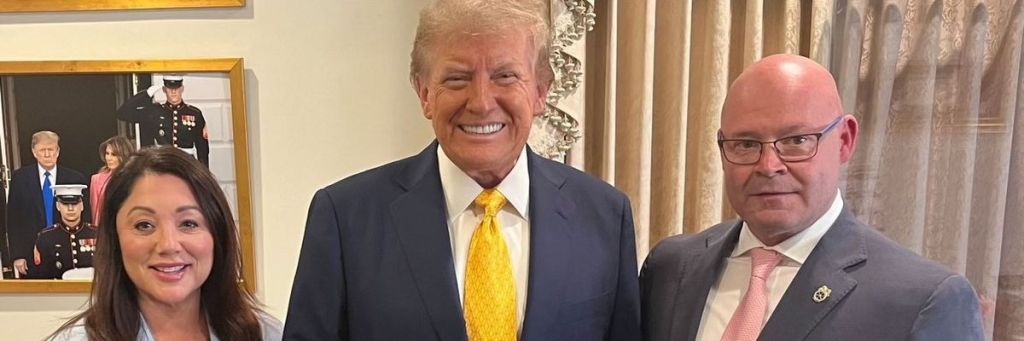
[Image – Teamsters president Sean O’Brien with President Trump and Republican congresswomen Lori Chavez-DeRemer]
Due in part by the Trump administration’s deliberate “flood the zone” strategy, and in part by the general theoretical underdevelopment of the US revolutionary movement, there is very little correct understanding of what Donald Trump and his administration represents in our mass and revolutionary movements. In this article, we begin to outline our analysis of Trump and his government, first by establishing a few fundamentals of what we feel like are key background trends that lead up to the second Trump Presidency, and then by providing a few basic theses on the Trump administration so far, and its implications for revolutionary labor.
In order to understand the Trump administration, we must first establish the broader trends of global imperialism which Trump exists within and is a manifestation of. The first trend we must touch on is the declining rate of profit under capitalism and the ever-intensifying crisis of the global imperialist system because of this and other contradictions. The second is the trend, as established by Lenin, of imperialism’s motion towards greater and greater monopolization and socialization, that is, towards greater and grater centralization and consolidation of production and capital. The third trend is the trend Lenin also touched on Imperialism: The Highest Stage of Capitalism, which is the international imperialist system’s trend towards greater and greater decay, parasitism, and dysfunction. The fourth related trend is what is referred either as the trend of increasing “reactionization” or “fascistization” of bourgeois democracies world-wide, that is, Chairman Gonzalo and the Communist Party of Peru’s thesis that capitalist democracies world-wide are increasingly abandoning the basic liberal-democratic principled they once embraced. The fifth trend is the trend of the world imperialist system away from the United States as the sole imperialist hegemon following the end of the Cold War, and towards a world imperialist system marked by multiple competing imperialist super-powers (in this case China, Russia, and the United States). Trump and his administration cannot be understood without understanding these trends, their causes, and their implications.
In addition to the general trends of the international imperialist system, to understand Trump we must also understand a few peculiarities and particularities of the United States, its society, and its political system. The first particularity we must understand is that the United States is a prison-house of nations, with the dominant oppressor nation being America, and the oppressed nations and national minorities being present in the US Black Belt, the Native reservations, the US Southwest border region, and the US overseas territories (Puerto Rico, Guam, US Virgin Islands, etc.) as well as Alaska and Hawaii. This is relevant to understanding Trump insofar as we must understand that in addition to managing the contradictions of class and foreign interests provoked by the global imperialist trends mentioned earlier, Trump must also manage the internal contradictions of American national chauvinism particular to our conditions, as well as the interests of an enlarged labor aristocracy based on the US’s hegemonic role in international imperialism. The second particularity we must understand is that the United States is not a typical parliamentary democracy, but has its own unique system of bourgeois democracy based on the US Constitution, which is a very antiquated and out-moded document even for a bourgeois constitution. Specifically, what is especially relevant to understanding Trump is that the US Constitution outlines a very simple and archaic division of powers without provisions for a modern capitalist administrative state, providing ample room for severe inter-bourgeoisie conflicts of interpretation and implementation. The third particularity we must understand is that of the two-party system. The United States has had two major parties since the early 1800s, and after passing through two prior party systems, has settled on the current Democratic-Republican party system (beginning with what is referred to as the Third Party System) since the end of the US Civil War in 1865. The two-party system is thus baked into our executive, legislative, and legal apparatuses, and one cannot understand Trump without understanding the contradictions and challenges caused by this anti-democratic and antiquated system in which two parties of power (usually divided by cultural liberalism versus cultural conservatism) nominally compete for control.
Moving past the objective materialist background for the current administration, our initial basic theses on Trump and the current political situation in the United States are as follows:
- Trump does not represent a rupture with past US imperialist policies, but rather is an intensification of policies and trends in US imperialism going back decades. That nothing Trump is doing is particularly new, even if it is in some places a dramatic acceleration of past patterns, or represents a return to certain reactionary policies that have not been applied on a mass scale for decades.
- The Trump government’s most important innovation and intensification of past imperialist powers are his dramatic moves to centralize governmental power within the executive branch, and in particular, within himself as THE executive. Trump’s administration and its legal supporters have taken the position that Constitution vests all executive power in the person of the President, and that while he may choose to delegate that power, ultimately he should have personal control over every single aspect of the executive branch (including things like foreign aid, the bureaucracy, how the congressional budget is spent, implementation of court orders, etc.). Thus, to take labor as an example, whereas Biden generally relied on the NLRB to carry out his labor policies, the Trump administration relies on the White House itself to make these interventions through cutting deals with favored state unions like the IBT, and attacking Democrat-aligned state unions like the AFL-CIO (similar to how Biden intervened in the UPS contract negotiations and ended the railroad worker strike).
- Trump has also expanded US state intervention into the economy, in comparison to all post Cold War presidents, just as each subsequent president has since the end of the Cold War. His tariff push, his attempt to exercise direct control over the Federal Reserve, his tax cuts (read – wealth distribution to the capitalists) funded by the US State’s deficit-spending, his direct deal-cutting and favor currying with major US monopolies and oligarchs: while done under the false banner of “de-regulation” all these represent examples of state intervention into the so-called “private economy”. This economic intervention is done in combination with the expansion of presidential power in a desperate attempt to halt or delay the decay and decline of US Imperialism through the work of a “vigorous and energetic Executive” to “streamline” the function of the US State.
- Trump has intensified the open cronyism and corrupt practices of US capitalism and its State. Things like the attempt to in-effect end the career civil service by making almost all government employees direct presidential appointees have increased the opportunities for graft, patronage, and cronyist attitudes. This is why we can see both the Republican-aligned and Democrat-aligned state unions cling even tighter to their political patrons, and all establishment line up behind the methods and practices of state unionism. As opportunists they see the only way for them to continue their pillage and domination of the labor movement is by becoming even more fanatic followers of their political masters, who in a more openly patronage-oriented political environment, will shower their agents with benefits and graft whenever possible.
- The Trump administration’s increase in its use of overt repression to attack the mass movement, in particular immigrant and LGBT workers, makes the pacifism and legalism of the state unionists all the more farcical and idiotic. Simply put, the Trump administration has made it clear the only authority it considers legitimate is its own, and inability of the public sector unions to reconcile with that reality speaks volumes. The will to organize a wild-cat strike for worker demands and in defense of their interests is the key dividing line between false and real unionism in the public sectors.
- Trump is not anti-state unionism, but rather is distrustful of all the so-called “independent agencies” created by Congress, and wishes to bring their function and jurisdiction directly under his control. This includes things like the NLRB and OSHA, and thus if things continue to progress as they have the last three months (which is no guarantee by any means!), we will be looking at an evolution of US state unionism to being increasingly presidentially-mediated rather than mediated through the administrative state and its welfare apparatus.
- The Trump administration’s tariff push, its focus on “revitalizing” domestic manufacturing, its environmental “de-regulation” and opening of federal lands to mining, oil, and gas projects: all of this is provoked by the militarization of US imperialism and its preparation for conflict with social-imperialist China. This militarization, and the flip to presenting economic policy within a narrow “national security” framework is bipartisan, and was reinforced in particular during the Biden administration through the passage of the CHIPS Act and the Build Back Better agenda. While this push will create some victors in US society, it will also result in a general impoverishment of the masses, which class-conscious workers should raise demands around and use to rouse the masses in struggle against the capitalists, their State, and its policies.
- The AFL-CIO’s reaction to these policies will be to double-down on their electoral opportunism, their servitude to the capitalist political class, and their willing-ness to sell the workers they organize out to the highest bidder. This has already occurred in dramatic fashion, especially among the public sector unions, and is not likely to reverse any time soon. The revolutionary and class-conscious workers must expose these failures and use them, along with the general crisis of US capitalism, to conduct organized agitation/propaganda in the workplaces and lead the workers in struggle around economic and political demands. In this way we must raise the workers’ class consciousness through mobilizing, politicizing, and organizing them via the organizations of New Labor and the class-conscious labor movement broadly.
- Taken as a whole, Trump has not established fascism in the United States, but represents a clear and serious step towards the ever-increasing fascistization of US society and government. In his interview, Chairman Gonzalo spoke about how: “We understand corporativism as the setting up of the state based on corporations, which implies the negation of parliamentarism. This is an essential point that Mariátegui gave emphasis to in “History of the World Crisis”. He said that the crisis of bourgeois democracy expresses itself clearly in the crisis of parliamentarism. Looking at the parliament here, while it is true that in the last decades it has been the executive branch that has produced the most important laws in this country, it is during this APRA government that the executive has monopolized the creation of all the fundamental laws for its own purposes. No important laws have come from the parliament. This is a fact, and everything has been aimed at giving powers to the executive so that it can do and undo as it pleases. Everything is a negation of parliamentarism.” We can rather clearly see then how Trump’s actions as regards using the executive to expand repression and social/economic intervention by negating Congress and the courts represent a step toward the setting up the US state based on corporations and monopolized Executive, the so-called “imperial presidency”.
In conclusion, what the class-conscious labor movement should take from this is that whether or not Trumpism stays in power for the next decade, the social, political and economic crisis of US society is only going to worsen due to the material trends and contradictions underlying the entire global imperialist system. While those who tie themselves to the sinking ship of the US State, and its ever shrinking “democratic rights” and base of support, will eventually sink themselves, they are in the short-term an enemy which we must learn to overcome and defeat strategically and tactically. Programs of struggle should be drawn up by the existing New Labor organizations, and these programs used to unite the unorganized workers and the existing spontaneous independent labor organizations on a common basis of politics and action. Revolutionaries for decades in the United States have pointed out the increasingly fascist tendencies of each administration, however for such analysis to have any meaning concrete steps must be taken. For example, in the current period the banner of the wildcat strike and the “unauthorized” economic action is a clear dividing line between class unionism and opportunism.
As workers are drawn to our movement by the failures of state unionism and the increasing misery faced by the broad masses, they must be trained up and new leaders developed who will in turn strengthen our organization and develop even more leaders, resulting in a new wave of trade union leaders from the class itself, and not outside of it. The struggle against Trump and all bourgeois politicians must be intensified, and rebellion of the workers given voice and organization by revolutionary labor.
 newlaborpress.org