by Fiona Wrench (PGH)
[Editor’s note: We are excited to publish this excellent report from a contact on the International Alliance of Theatrical Stage Employees’ (IATSE or IA) recent sell-out tentative agreements. The report comes from the shop paper “Strike The Stage”. For those working under IATSE jurisdictions who are interested in reaching out, or for those with any follow-up questions on the article, please contact Strike The Stage archive]
The IATSE negotiating committees for the Hollywood Basic Agreement (HBA) and Area Standards Agreement (ASA) have reached tentative agreements with the Alliance of Motion Picture and Television Producers (AMPTP). These contracts set the standard for every film local in the IA.
For the last year and a half film crews have been stretched incredibly thin. While the WGA and SAG-AFTRA went on strike, IATSE film crews were out of work without strike pay while IATSE marched around “in solidarity.” TV and movie producers have stalled production while HBA and ASA negotiations are ongoing, which amounts to a lockout, ramping up the pressure on film workers to accept whatever “deal” is forced on them. And when work in film is slow, many would-be film workers become stagehands, causing strain on workers in the entire industry.
Stagehands share many of the harsh working conditions faced by film workers, like extremely long working days and short turnarounds, and any stagehands interested in improving their conditions and fighting for control over their work will have to contend with IATSE’s influence on our side of the industry too. This is not a matter determined only by the locals under the HBA and ASA, since the International has significant power over the contracts according to IATSE’s constitution and bylaws—only the President can approve a strike, and the contracts have to be approved by the International. Local officials who oppose these rules are subject to discipline or expulsion, or they can have their local charter revoked. So film crews and stagehands alike all have a vested interest in the outcome of the negotiations.
At the time of writing, IATSE has not yet released the full contract language, so a more detailed analysis of the TAs will come in the next edition. For now I’ll focus on the HBA since it’s the larger of the two contracts and the ASA is very similar. By releasing a summary of “highlights” meant to make the TA look better than it is, IATSE has already started to push the TA on membership before the contract language has even been released. A summary released in an email and hosted on basic.iatse.net says that rates will increase by 7%, 4%, then 3.5% compounded over the next three years—a total wage increase of 15.17% by 2027. But inflation increased by 17% between January 2021 and December 2023, so the proposed “increase” actually amounts to a pay cut. In response to overwhelming demand for shorter working days and a shorter work week, the Negotiating Committee has proudly announced triple-time pay for working days past 15 hours and double-time pay for work on the seventh day of the work week, which comes off like a sick joke that does nothing to change the current standard where 14-hour days are common despite double-time pay already being in place past 12 hours. It’s not even unusual for workers to crash and die driving home from set after back-to-back marathon shifts. A minimum turnaround time is not addressed in the summary. Delaying the release of the full contract language allows IATSE to spring the TA on its members without adequate time to review the TA in-depth and organize opposition to it before the current contract expires on July 31st.
The industry press monopolies, representing the producers, have a united front in support of the TA. The LA Times writes that the TA’s arrival before the expiration deadline “finally [permits] the entertainment industry to breathe a sigh of relief in the wake of two marathon strikes waged by actors and screenwriters.” Variety writes that if passed, the TA “will calm fears of another industry shutdown so soon after last year’s double strikes.” Deadline urges that a “smooth” passing of the Area Standards Agreement “could usher in a rare lack of labor anxiety for a town and an industry still reeling from the pandemic, some bad business decisions, and last year’s WGA and SAG-AFTRA strikes.”
All of these statements are predicated on the fantasy of a potential IATSE strike, even though IATSE has never led a national strike, and year after year reports $0 allocated to strike benefits to the Department of Labor. Producers are able to halt production and lockout workers because they know years in advance when a contract is going to end, allowing them to stockpile content to keep themselves afloat in the event of a strike. But there is no way the producers fear a strike from IATSE. Plus, Warner Bros. Discovery, Netflix, and Disney have all increased their profits every year since 2021. Apple, Sony, and Paramount have had some declines in profits since 2021. They’re far from operating at a loss, still pulling in billions in profits. And they’ve put film workers in a dire spot by stalling production during the negotiations. And there’s always the threat of moving production out of Hollywood like they’ve been threatening to for decades now—what’s stopping them? So whose “relief” are they talking about?
Throughout the negotiations, IATSE kept members in the dark. Negotiations began without any disclosure of or vote on concrete proposals. In fact, no details about proposals or measures were given to any members, only vague updates about undefined “improvements” in a list of the topics being discussed. All members got was a pessimistic survey in 2023 about contract priorities. It’s bizarre to see the negotiating committee write in the TA announcement: “From start to finish, your input was invaluable and ensured that our Negotiations Committee was at the bargaining table with clear goals (?) and a consensus (!) for how to achieve them.”
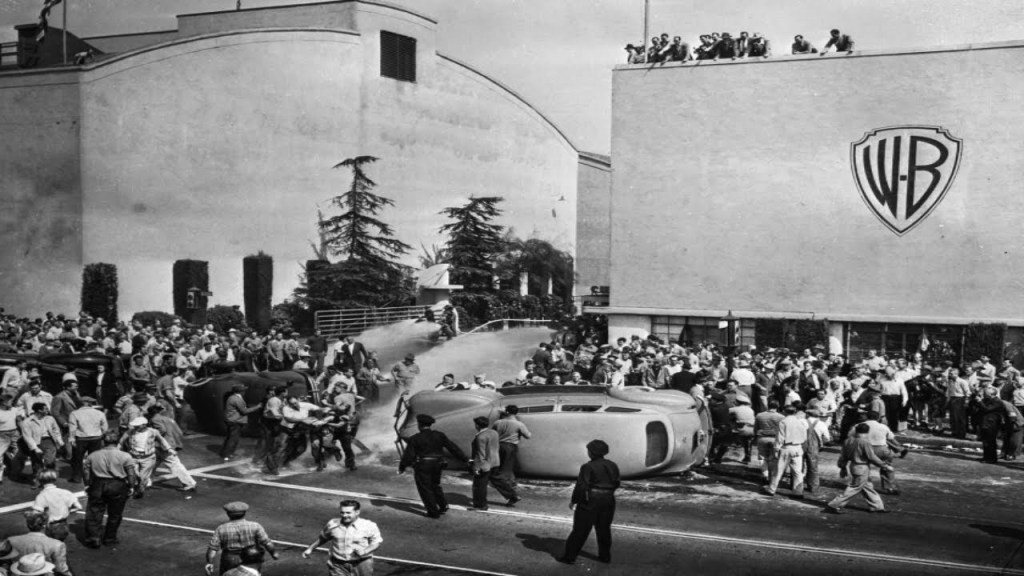
None of this should come as a surprise, since IATSE has never protected film workers in Hollywood. From 1934 to 1941, IATSE President George E. Browne extorted millions from Hollywood producers for the Chicago Outfit in exchange for low wages and no strikes. After Richard F. Walsh, VP under Browne, took over between 1941-1974 after Browne’s conviction, there has been an unbroken line of successors, each appointed by the previous President, up to Matthew Loeb today. In the late 40s, a mobbed-up IATSE fought a bloody war to break strikes, scab, and drive the more militant Conference of Studio Unions out of Hollywood.
In 1989 IATSE “negotiators” colluded with the AMPTP to impose a contract on the HBA locals that ended double-time pay on weekends and removed night-time premium wage differentials. IA President Al Di Tolla and AMPTP head Nicolas Counter III together lauded the 1989 HBA as “one of the most progressive contracts ever negotiated in the entertainment industry.” Conditions in 1989 were similar to today: while the WGA went on strike for 22 weeks, IATSE postponed negotiations with the AMPTP for six months, guaranteeing a weaker position for themselves. The ’89 TA was met with outrage and was ratified in an eerily similar fashion as the widely-hated 2021 contract that did not even attempt to fight for 12 hours on and 12 hours off. Members voted against the ’89 HBA 49% yes to 51% no, but delegates voted in favor 58%-42% because of IATSE’s electoral college system: a simple majority in one local means all its delegates vote that way. In 2021, the HBA was voted down 49.6%-50.4% by members, with 72% turnout, but delegates passed it 55% to 45%, and all this in spite of an overwhelming strike authorization vote that received 98% of votes in favor, with 90% turnout. Since the 1989 HBA, IATSE members have been bullied into accepting contract after contract with never more than a 3% wage increase, alongside cuts and freezes to certain positions and a continual decline in working conditions.
IATSE is able to force these contracts on its members by keeping them disorganized and unprepared for the prospect of a strike, hiding the negotiations from them, then springing a TA before the deadline amid threats, saying voting the TA down means going on strike, and members are not prepared to strike! In 2018 Leslie Simon, Business Representative for Local 871 told her members, “You should not vote against this deal unless you are ready to strike, and believe that the vast majority of your colleagues are ready to do the same… I don’t advocate lightly for striking and believe that strikes take a lot of internal organizing prior to negotiations in order to be successful. I urge you all to take time in considering what a strike would mean for you and your families…” [emphasis added]. How is this anything but a blatant threat? Instead of urging members to consider the consequences of a “strike,” it would have been more appropriate to call it a lockout, since that’s all this self-confessed lack of preparation amounts to.
The International and local officials could have prepared IATSE members for a strike by staying in close contact with them, informing them about the financials of the producers and the balance of power going into negotiations, educating them on who their real friends and enemies are, drawing up proposals based on workers’ grievances, teaching us about strike tactics based on the history of the labor movement, and organizing smaller-scale economic actions like slowdowns and walkouts to practice collective action in preparation for a strike—they also could have put more than $0 into the union’s strike fund. But as the “loyal opposition” of the AMPTP, it is not in the International’s interest to do these things. IATSE is a federally-regulated organization whose purpose is to force collaboration between workers and those who exploit them. That’s why they impose concessions on their members and prevent them from taking action against the AMPTP.
 newlaborpress.org