There are people promoting ideas of all sorts in the labor movement. By far the dominant ideology is labor-liberalism: all the state unions spend massive amounts of money and man-hours on the Democratic Party and take up jobs in the government and party. The second most prominent ideology is Trotskyism—it is the Trotskyists who established groups such as Teamsters for a Democratic Union which have functioned as a crucial pillar propping up the decrepit state unions over the last few decades. It is therefore important to lay out the basic features of Trotskyism in the labor movement and in general as well as some specific experiences with Trotskyism.
Trotsky and the Origins of Trotskyism
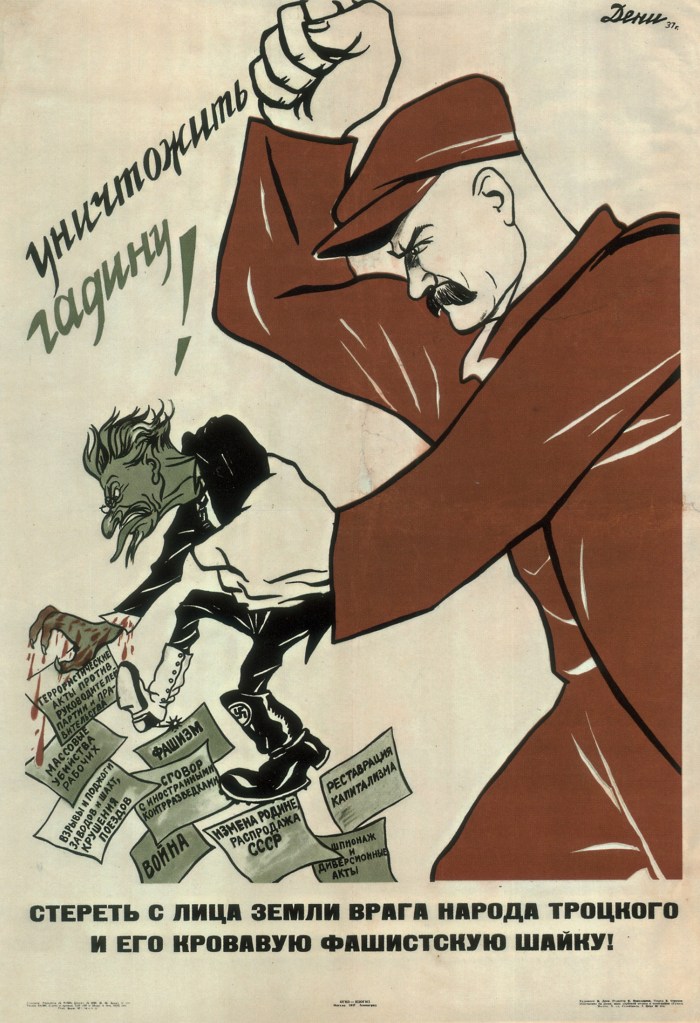
Trotskyism as an ideology gets its name from the Soviet defector Leon Trotsky. Trotsky had a lengthy record of vacillating between the different political trends in Russia, to the point that Lenin referred to him as “Judas Trotsky” and Stalin aptly said, “But it is precisely to such depths [preparing for civil war against the Soviet state] that the Trotskyists have sunk—once a faction within the Party, they have now become an underground anti-Soviet organisation” [They Have Sunk to New Depths, 1929]. As a historical figure, Trotsky’s record is abysmal. He took a centrist stand between Mensheviks (representatives of the Russian liberal bourgeoisie) and Bolsheviks (revolutionary workers and peasants) in Russia. He temporarily sided with the Bolsheviks to try to wreck the Brest peace accords which ended Russian involvement in WW1 (more on the “theory” that justified this later), then went on to propose turning the Soviet Union into a fascist dictatorship by imposing military discipline in the trade unions and “turning the screws” on the poor peasants who he claimed were incapable of building socialism, while opposing the expropriation of the rich peasants. (This process, which included harsh repressive measures, is more commonly known as “dekulakization”.) When the entire Soviet people including the Communist Party rejected this, he took to factionalism (which is what Trotskyists are most known for today) for the purpose of sabotaging the Soviet government and economy, and fled the country. In the US he agreed to testify in front of the Dies Committee against the Soviet Union and ultimately took a centrist position on fascism: “Being an irreconcilable opponent not only of fascism but also of the present-day Comintern, I am at the same time decidedly against the suppression of either of them” [Trotsky, Why I Agreed to Appear Before the Dies Committee, 1939]. Trotsky was thus the figurehead of centrism from the beginning to the end of his career, starting with a compromise with Russian liberalism (known as the August bloc) and ending with a compromise with Hitlerite fascism, which Trotsky saw as a lesser evil to Stalinism. (“No one, not excluding Hitler, has dealt socialism such deadly blows as Stalin” [Trotsky, The Beginning of the End, 1937]).
Trotsky was only one person, and not even a particularly talented one at that. Nevertheless Trotskyism has become a global phenomenon, with many Trotskyist parties acquiring posts in different governments. This is to be explained by the fact that Trotskyism as an ideology is extremely appealing to the middle classes, who theoretically should want and would benefit from a revolution, but in fact constantly flip-flop and practically reject the proletarian revolution and everything that is required to carry it out successfully. As Moissaye Olgin, a Ukrainian Jew who fled Eastern Europe and joined the CPUSA, wrote in 1935:
“Trotskyism is being reborn on every stage of the revolutionary movement because it is the expression of the attitude of a certain class, namely, the petty bourgeoisie. Of this class Karl Marx once said that it is ‘a transitional class in which the interests of two classes are simultaneously blunted’. The petty bourgeoisie finds itself between the proletariat and the large-scale bourgeoisie. It strives to rise to the position of the large-scale bourgeoisie, but the latter, using the power of concentrated and centralized capital, continuously drives it down to the position of the proletariat. The petty bourgeois, subjectively, wishes to become rich, to attain to the heights of capitalist economic power; objectively, however, his interests lie with the struggle against capitalism because capitalism removes the ground from under his feet and because only under a Socialist system will the petty bourgeois of today become a free member of society, unafraid of the future, since under Socialism he will be transformed into one engaged in useful productive labor. The petty bourgeoisie as a class, therefore, is wavering. The interests of two classes, said Marx, are ‘simultaneously blunted’ in it. That means that the petty bourgeoisie cannot be as consistently counter-revolutionary as the big bourgeoisie, but it cannot be as consistently with the revolution, as is the proletariat. The petty bourgeoisie is afraid of the big bourgeoisie but it is also afraid of the revolution” [Trotskyism: Counter-revolution in Disguise].
These are the historical facts and the social basis of Trotskyism. Theoretically, the main ideas of Trotskyism are “permanent revolution” and “transitional programs”. “Permanent revolution” is the theory that socialism cannot be built in one country. This “theory” is in part how the Trotskyists justify their unprincipled behavior. If socialism is impossible to develop in one country, then it logically follows that wrecking socialism is also impossible in one country, because such a process was impossible to begin with. Thus the betrayals of Trotsky and the Trotskyists are completely erased! The ideological premise of “permanent revolution” taken to its conclusion means alliance with the labor-liberals. (See Lenin’s On the Two Lines in the Revolution for more on this.).
The “transitional program” on the other hand is the idea that instead of working to link minimum demands (like higher wages) with maximum demands (like the dictatorship of the proletariat), revolutionaries should put forward what Trotskyists call “transitional demands” which are both not revolutionary and also impossible to achieve under capitalism (Trotsky gives the example of “employment and decent living conditions for all”). The ridiculous theory behind this is that workers will realize these demands are impossible to achieve under capitalism and then develop revolutionary consciousness. But even worse, in practice it means literally enshrining opportunism as a part of their ideology, because you have now codified mass campaigns never being revolutionary nor successful/achievable and thus permanently justified the classic Trotskyist behavior of opportunistically jumping around from failed campaign to failed campaign endlessly pursuing a magical spontaneous “transition” to revolutionary consciousness.
Trotskyism is a “socialism” that rejects the possibility of actually building socialism in any one country. They are “trade unionists” who reject any trade union activity not sanctioned by the bourgeois state. They are “Marxists” who reject basic Marxist concepts and replace them with liberal ideas. In a word, they are political frauds.
Trotskyism in the Labor Movement
Nowhere is the political fraudulence of the Trotskyists more obvious than in the labor movement. As a clear example, for half a century now, the Trotskyists have been carrying out a factional fight for the ill-gotten spoils of the International Brotherhood of Teamsters. It was pointed out in New Day at UPS Edition #15 that, “TDU [Teamsters for a Democratic Union] must be understood as a reactionary organization aimed at propping up the crumbling dictatorship of the IBT in the logistics industry.” What was not mentioned was that TDU was originally a Trotskyist front run by the International Socialists [sic!] for acquiring money and jobs from the IBT. In fact, the modus operandi of Trotskyism in the labor movement is to establish a caucus within a reactionary organization (IBT, UAW, SMART, UFCW, etc) then use that to channel support back into the reactionary organization in the name of a reformist slate. That way, they can never be criticized (they are the opposition slate after all!) while still reaping the benefits of the union bureaucracy. And if they are unambiguously “caught in the act” of class collaboration, as happened with the rail unions in 2022 and the IBT-UPS contract in 2023, then its a simple matter of setting up yet another caucus to launder candidates through. (As was done by Teamsters Mobilize, which immediately set about “criticizing” New Day at UPS and laundering the reputation of IBT VP John Palmer.)
Consider the following experiences with Trotskyism.
In April of 2023 a Trotskyist group called “Independent Socialist Group” held a panel ostensibly for UPSers even though all but one of the speakers did not work at UPS. At this panel they outlined their vision of the upcoming contract. A supporter of Railroad Workers United who did not work at UPS said that we need to trust O’Brien and that it does not matter if he betrays the UPSers. This was said six months after O’Brien helped the government impose a contract on the rail workers after they rejected it. The ISG put forward a “demand” of $21/hour even though this was below UPS’ market adjusted pay at that time. (In fact, the Trotskyists were students who worked at UPS part time and were making 8+ dollars more than full timers in progression who had been there way longer—such is the social basis and the sanctimoniousness of the Trotskyists.) One of them agreed to be the recording secretary of the local. Then, months later once the sellout became absolutely undeniable, the ISG completely reversed positions and said $21/hour was a sellout wage. They published three headlines right in a row: one covering up the reactionary role of the IBT in helping suppress the 1934 Minneapolis general strike (“Teamster Rebellion: Revive the Spirit of 1934 to Win in 2023!”), one taking a centrist stance on the contract (“UPS Teamster Tentative Agreement Reached: Does it Meet Workers’ Needs?”) and once it was way too late, then they took a halfhearted oppositional stance on the contract while never breaking ties with the IBT itself (“UPS Teamsters: Vote No on the Tentative Agreement!”). This group is so deceptive that they decided to call themselves the “Independent Socialist Group” even though they are not independent, but rather a split from Socialist Alternative that affiliated to the Committee for a Workers’ International. That is the level of fraudulence of the Trotskyists!
One of the largest Trotskyist groups in the country outright lied about UPS in a way that benefited UPS corporate. In July of 2023, Socialist Alternative published the following: “It was rank-and-file Teamsters – drivers, inside workers, and part-timers all working to prepare for the strongest possible strike – who created the pressure from outside of the bargaining table to improve the TA.” [Rank-And-File UPS Teamsters & Workers Strike Back Activists: Vote NO And Escalate The Fight For A Strong Contract!, 28 July 2023 retrieved from socialistalternative.org] This one sentence is a triple deception of the workers.
1. “Strongest possible strike”—no strike was prepared period, and the IBT never claimed to be organizing one. The IBT’s policy was of organizing “practice pickets” as part of a “credible strike threat”, essentially just a performance put on for the public relations boost and to placate the membership. In actual fact the IBT was against the preparation of a strike by the New Day supporters.
2. “Improve the TA”—zero information was ever provided regarding the specific proposals from the company and the union. For all anyone knows, the IBT accepted the company’s first offer but decided to keep this secret (since it would make them look bad) and simply waited until the end of July to announce the TA. This is just a repetition of what the IBT says happened, that the practice pickets forced UPS to accept their “historic contract”, and directly benefits UPS, since it makes them look like they were held accountable by their workers, when in actual fact UPS got exactly what it wanted.
3. “Pressure from outside of the bargaining table”—the Trotskyists can’t admit that this came mainly from the White House, not “rank and file Teamsters” who had literally nothing to do with the entire process, and this was intentional on the part of the IBT.
The “big tent” publication of the Trotskyists, Social Democrats, and Kautskyists, Cosmonaut, promoted TDU and the “rank and file strategy” relentlessly, clear through the period of the election of Sean O’Brien to General President of the IBT. Then, when he didn’t strike and instead imposed a sellout contract on the UPSers, just as the New Dayers said would happen… Cosmonaut criticized New Day at UPS as “crass” and “impetuous”. This is the queer logic of Trotskyism at work. Their “criticism” of the liberals is perpetually too little too late, while their “criticism” of the communists and principled trade union elements is just plain slander, if not actual red baiting. (Recall that Cosmonaut referred to New Day as “Gonzaloite” with zero citations just like their claim of “sectarian”.)
The situation is not different for Trotskyists at other firms. The behavior of the Socialist Alternative “organizers” at Amazon KCVG is absolutely textbook Trotskyism. In the last year alone, the International Brotherhood of Teamsters called off a strike at Yellow and the company completely liquidated. The IBT also called off two strikes at UPS (both of which were just lies from the start—one for the sellout 2023 contract and one over a dozen or so administrative employees not getting recognized in the Worldport hub). Yet the Socialist Alternative Trotskyists are selling IBT representation to Amazonians… on the spurious grounds that they will help them strike Amazon alongside the DHL and UPS workers! Think how strange it is that while the Amazon Trotskyists try to sell the IBT as a bastion of trade union militancy, the UPS Trotskyists try to sell themselves as militant critics of the class-collaborationist IBT!
There are no accidents for the Trotskyists. If they seem to be misrepresenting their views and wrecking organizing efforts, it’s because they are. Trotskyism as an ideology rejects basic necessities of organizing such as discipline, criticism and self-criticism, and hostility to opportunism. In a nutshell, it is the ideology of the rat because it values “coalition building”, “alliances”, “united fronts” with the liberal bourgeoisie and the bourgeois elements of the labor movement above all else. The proletariat can only depend on its own discipline and unity for victory, and it is precisely these things the Trotskyists reject. In place of proletarian discipline and unity around proletarian ideology, the Trotskyists have as their “weapons” bourgeois discipline (which means obedience to one’s own factional interests above all else) and unity around bourgeois ideas, especially the old liberal ideas such as pure democracy and absolute freedom of discussion. In no country has Trotskyism led to anything positive for the workers. Even just in the US, Trotskyism has an abominable record of supporting the gangster fascist elements in the labor movement, even during the Tobin era of the IBT. Trotskyism raises unprincipledness to the level of a principle—this is why it is literally the ideology of rats. Their principles superficially resemble those of the communists and the trade unionists. But that’s all it is, superficial resemblance—in actual fact the Trotskyists value unity with the wreckers and traitors against socialism and trade unionism above all else.
Conclusion
This is not an obscure academic debate nor is it a minor point of disagreement among socialists. Literally everywhere they go, the Trotskyists infiltrate the organizations of the workers for the purposes of converting them into profiteering enterprises run for the benefit of the Trotskyists. This wrecking, splitting, and diversionary work directly benefits the capitalists and harms the workers. It is not an accident that all the worst elements in the labor movement, including the gangster O’Brien clique in the IBT, were promoted in the Trotskyist press and have Trotskyists on their payroll. This was the result of the bankruptcy of a political tendency based on false premises. The first false premise: there can be unity between the workers and the bourgeois elements of the labor movement. The second false premise: the bourgeois elements of the labor movement can be “pushed left”. The third false premise: the state unions are legitimate trade union organizations that are in the process of being “transitioned” to revolutionary consciousness, or can be with the right amount of rank-and-file involvement in them.
The Trotskyists have a 90-year-long unbroken record of class collaborationism in the American labor movement. From their role in sabotaging the Minneapolis general strike in 1934 to promoting illusions about the O’Brien administration in the leadup to the 2023 contract, every time without exception there are Trotskyists pointing the workers in the complete wrong direction. There is nothing the government’s labor bureaucrats could do to the workers that the Trotskyists would consider “too far”. Any organizing committee that accepts the participation of the Trotskyists might as well accept delegates from corporate, because that is who the Trotskyists represent.
From the standpoint of the workers, there are decisions that are objectively right and decisions that are objectively wrong. It is objectively wrong to wreck the trade union struggle of the Amazon workers by promoting lies about the IBT. It is objectively wrong to subordinate the Amazon organizers to Amazon via the IBT. And if the Amazon workers agree this is wrong, once the Trotskyists feel like their backs are really against the wall, they will resort to the liberal arguments about freedom of opinion and take to slandering the workers as “Stalinists”, simply because their position is indefensible from the standpoint of the objective interests of the Amazonians. Trotskyism as an ideology defends the existence of incorrect ideas among the workers and works towards their further propagation. In a time when there is a serious dearth of information regarding the concrete conditions on the shop floors and in the state unions, and when all sorts of backwards ideas hold sway over the workers, the Trotskyists are looking to profiteer off this collective ignorance. For this reason, educating the workers in the trade union struggle necessarily implies educating them on the fraudulence of the Trotskyists as part of breaking with wrong ideas generally.
 newlaborpress.org